Distributed minimum spanning tree

The distributed minimum spanning tree (MST) problem involves the construction of a minimum spanning tree by a distributed algorithm, in a network where nodes communicate by message passing. It is radically different from the classical sequential problem, although the most basic approach resembles Borůvka's algorithm. One important application of this problem is to find a tree that can be used for broadcasting. In particular, if the cost for a message to pass through an edge in a graph is significant, an MST can minimize the total cost for a source process to communicate with all the other processes in the network.
The problem was first suggested and solved in 



01Overview
The input graph 

At the beginning of the algorithm, nodes know only the weights of the links which are connected to them. (It is possible to consider models in which they know more, for example their neighbors' links.)
As the output of the algorithm, every node knows which of its links belong to the minimum spanning tree and which do not.
02MST in message-passing model
The message-passing model is one of the most commonly used models in distributed computing. In this model, each process is modeled as a node of a graph. Each communication channel between two processes is an edge of the graph.
Two commonly used algorithms for the classical minimum spanning tree problem are Prim's algorithm and Kruskal's algorithm. However, it is difficult to apply these two algorithms in the distributed message-passing model. The main challenges are:
- Both Prim's algorithm and Kruskal's algorithm require processing one node or vertex at a time, making it difficult to make them run in parallel. For example, Kruskal's algorithm processes edges in turn, deciding whether to include the edge in the MST based on whether it would form a cycle with all previously chosen edges.
- Both Prim's algorithm and Kruskal's algorithm require processes to know the state of the whole graph, which is very difficult to discover in the message-passing model.
Due to these difficulties, new techniques were needed for distributed MST algorithms in the message-passing model. Some bear similarities to Borůvka's algorithm for the classical MST problem.
03GHS algorithm
The GHS algorithm of Gallager, Humblet and Spira is one of the best-known algorithms in distributed computing theory. This algorithm constructs an MST in the asynchronous message-passing model.
Assumptions
The GHS algorithm requires several assumptions.
- The input graph is connected and undirected.
- Each edge in the input graph has distinct finite weights. This assumption is not needed if there is a consistent method to break ties between edge weights.
- Each node initially knows the weight of each edge incident to that node.
- Initially, each node is in an inactive state. Each node either spontaneously awakens or is awakened by receipt of any message from another node.
- Messages can be transmitted independently in both directions on an edge and arrive after an unpredictable but finite delay, without error.
- Each edge delivers messages in FIFO order.
Properties of MSTs
Define a fragment of an MST 
- Given a fragment of an MST
be a minimum-weight outgoing edge of the fragment. Then joining
- If all the edges of a connected graph have different weights, then the MST of the graph is unique.
These two properties form the basis for proving correctness of the GHS algorithm. In general, the GHS algorithm is a bottom-up algorithm in the sense that it starts by letting each individual node be a fragment, and then joining fragments until a single fragment is left. The above properties imply that the remaining fragment must be an MST.
Description of the algorithm
The GHS algorithm assigns a level to each fragment, which is a non-decreasing integer with initial value 0. Furthermore, each fragment with a non-zero level has an ID, which is the ID of the core edge in the fragment, which is selected when the fragment is constructed. During the execution of the algorithm, each node can classify each of its incident edges into three categories:
- Branch edges are those that have been determined to be part of the MST.
- Rejected edges are those that have been determined not to be part of the MST.
- Basic edges are all edges that are neither branch edges nor rejected edges.
In level-0 fragments, each awakened node will do the following:
- Choose its minimum-weight incident edge and mark that edge as a branch edge.
- Send a message via the branch edge to notify the node on the other side.
- Wait for a message from the other end of the edge.
The edge that is chosen by the two nodes it connects becomes the core edge, and is assigned level 1.
In non-zero-level fragments, a separate algorithm is executed in each level. This algorithm can be separated into three stages: broadcast, convergecast, and change core.
Broadcast
The two nodes adjacent to the core broadcast messages to the rest of the nodes in the fragment. The messages are sent via the branch edge but not via the core. Each broadcast message contains the ID and level of the fragment. At the end of this stage, each node has received the new fragment ID and level.
Convergecast
In this stage, all nodes in the fragment cooperate to find the minimum weight outgoing edge of the fragment. Outgoing edges are edges connecting to other fragments. The messages sent in this stage are in the opposite direction of the broadcast stage. Initialized by all the leaves (the nodes that have only one branch edge), a message is sent through the branch edge. The message contains the minimum weight of the incident outgoing edge it found (or infinity if no such edge was found). The way to find the minimum outgoing edge will be discussed later. For each non-leaf node, given the number of its branch edges as 

Change core
After the completion of the previous stage, the two nodes connected by the core can inform each other of the best edges they received. Then they can identify the minimum outgoing edge from the entire fragment. A message will be sent from the core to the minimum outgoing edge via a path of branch edges. Finally, a message will be sent out via the chosen outgoing edge to request to combine the two fragments that the edge connects. Depending on the levels of those two fragments, one of two combined operations are performed to form a new fragment; details discussed below.
Finding the minimum-weight incident outgoing edge
As discussed above, every node needs to find its minimum weight outgoing incident edge after the receipt of a broadcast message from the core. If node 
. That is, nodes
and
. That is, nodes
. We cannot make any conclusion. The reason is that the two nodes may belong to the same fragment already, but node
Combining two fragments
Let 

- Merge: This operation occurs if both
. The level of the combined fragment will be
.
- Absorb: This operation occurs if
. The combined fragment will have the same level as
Furthermore, when an "Absorb" operation occurs,
- Node
, so we want to find the minimum weight outgoing edge of
- Node
is the chosen edge, we can conclude the following:


Maximum number of levels
As mentioned above, fragments are combined by either "Merge" or "Absorb" operation. The "Absorb" operation does not change the maximum level among all fragments. The "Merge" operation may increase the maximum level by 1. In the worst case, all fragments are combined with "Merge" operations, so the number of fragments decreases by half in each level. Therefore, the maximum number of levels is 
Progress property
The GHS algorithm has a nice property that the lowest level fragments will not be blocked, although some operations in the non-lowest level fragments may be blocked. This property implies the algorithm will eventually terminate with a minimum spanning tree.
04Approximation algorithms
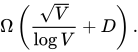
An 


Sources and credits
This article is adapted from the Wikipedia article “Distributed minimum spanning tree”, written by its contributors and licensed under CC BY-SA 4.0. Fathomly has changed the layout, removed citation markers, navigation and maintenance notices, and adjusted punctuation. This adapted version is shared under the same license. For references, see the original article.
Images, from Wikimedia Commons:
- Minimum spanning tree.svg by No machine-readable author provided. Dcoetzee assumed (based on copyright claims)., Public domain
Fathomly is not affiliated with or endorsed by the Wikimedia Foundation. Spotted a problem? Tell us.