Discount function
Economic model which weighs rewards based on when they are received
In economics, a discount function is used in economic models to describe the weights placed on rewards received at different points in time. For example, if time is discrete and utility is time-separable, with the discount function f(t) having a negative first derivative and with ct (or c(t) in continuous time) defined as consumption at time t, total utility from an infinite stream of consumption is given by:
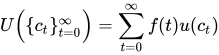
Total utility in the continuous-time case is given by:

provided that this integral exists.
Exponential discounting and hyperbolic discounting are the two most commonly used examples.
Sources and credits
This article is adapted from the Wikipedia article “Discount function”, written by its contributors and licensed under CC BY-SA 4.0. Fathomly has changed the layout, removed citation markers, navigation and maintenance notices, and adjusted punctuation. This adapted version is shared under the same license. For references, see the original article.
Fathomly is not affiliated with or endorsed by the Wikimedia Foundation. Spotted a problem? Tell us.