Director string
In mathematics, in the area of lambda calculus and computation, directors or director strings are a mechanism for keeping track of the free variables in a term. Loosely speaking, they can be understood as a kind of memoization for free variables; that is, as an optimization technique for rapidly locating the free variables in a term algebra or in a lambda expression. Director strings were introduced by Kennaway and Sleep in 1982 and further developed by Sinot, Fernández and Mackie as a mechanism for understanding and controlling the computational complexity cost of beta reduction.
01Motivation
In beta reduction, one defines the value of the expression on the left to be that on the right:
or
(Replace all x in E(body) by y)
While this is a conceptually simple operation, the computational complexity of the step can be non-trivial: a naive algorithm would scan the expression E for all occurrences of the free variable x. Such an algorithm is clearly O(n) in the length of the expression E. Thus, one is motivated to somehow track the occurrences of the free variables in the expression. One may attempt to track the position of every free variable, wherever it may occur in the expression, but this can clearly become very costly in terms of storage; furthermore, it provides a level of detail that is not really needed. Director strings suggest that the correct model is to track free variables in a hierarchical fashion, by tracking their use in component terms.
02Definition
Consider, for simplicity, a term algebra, that is, a collection of free variables, constants, and operators which may be freely combined. Assume that a term t takes the form

where f is a function, of arity n, with no free variables, and the 

from the free variables to the power set 



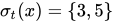
Thus, for every term 

03General case
Although the above definition is formulated in terms of a term algebra, the general concept applies more generally, and can be defined both for combinatory algebras and for lambda calculus proper, specifically, within the framework of explicit substitution.
Sources and credits
This article is adapted from the Wikipedia article “Director string”, written by its contributors and licensed under CC BY-SA 4.0. Fathomly has changed the layout, removed citation markers, navigation and maintenance notices, and adjusted punctuation. This adapted version is shared under the same license. For references, see the original article.
Fathomly is not affiliated with or endorsed by the Wikimedia Foundation. Spotted a problem? Tell us.