Concentration
Ratio of part of a mixture to the whole
In chemistry, concentration is the abundance of a constituent divided by the total volume of a mixture. Several types of mathematical description can be distinguished: mass concentration, molar concentration, number concentration, and volume concentration. The concentration can refer to any kind of chemical mixture, but most frequently refers to solutes and solvents in solutions. The molar (amount) concentration has variants, such as normal concentration and osmotic concentration. Dilution is reduction of concentration, e.g., by adding solvent to a solution. The verb "to concentrate" means to increase concentration, the opposite of dilute.
01Etymology
Concentration-, concentratio, action or an act of coming together at a house on a farm in a single place, was used in post-classical Latin in 1550 or earlier, similar terms attested in Italian (1589), Spanish (1589), English (1606), French (1632).

02Qualitative description
Often in informal, non-technical language, concentration is described in a qualitative way, through the use of adjectives such as "dilute" for solutions of relatively low concentration and "concentrated" for solutions of relatively high concentration. To concentrate a solution, one must add more solute (for example, alcohol), or reduce the amount of solvent (for example, water). By contrast, to dilute a solution, one must add more solvent, or reduce the amount of solute. Unless two substances are miscible, there exists a concentration at which no further solute will dissolve in a solution. At this point, the solution is said to be saturated. If additional solute is added to a saturated solution, it will not dissolve, except in certain circumstances, when supersaturation may occur. Instead, phase separation will occur, leading to coexisting phases, either completely separated or mixed as a suspension. The point of saturation depends on many variables, such as ambient temperature and the precise chemical nature of the solvent and solute.
Concentrations are often called levels, reflecting the mental schema of levels on the vertical axis of a graph, which can be high or low (for example, "high serum levels of bilirubin" are concentrations of bilirubin in the blood serum that are greater than normal).
03Formulation
There are four quantities that describe concentration:
Mass concentration
The mass concentration 


The SI unit is kg/m3 (equal to g/L).
Molar concentration
The molar concentration 


The SI unit is mol/m3. However, more commonly the unit mol/L (= mol/dm3) is used.
Number concentration
The number concentration 


The SI unit is 1/m3.
Volume concentration
The volume concentration 


Being dimensionless, it is expressed as a number, e.g., 0.18 or 18%.
There seems to be no standard notation in the English literature. The letter
04Related quantities
Several other quantities can be used to describe the composition of a mixture. These should not be called concentrations.
Normality
Normality is defined as the molar concentration 
Molality
The molality of a solution 

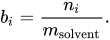
The SI unit for molality is mol/kg.
Mole fraction
The mole fraction 


The SI unit is mol/mol. However, the deprecated parts-per notation is often used to describe small mole fractions.
Mole ratio
The mole ratio 
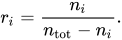
If
The SI unit is mol/mol. However, the deprecated parts-per notation is often used to describe small mole ratios.
Mass fraction
The mass fraction 


The SI unit is kg/kg. However, the deprecated parts-per notation is often used to describe small mass fractions.
Mass ratio
The mass ratio 
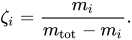
If
The SI unit is kg/kg. However, the deprecated parts-per notation is often used to describe small mass ratios.
05Dependence on volume and temperature
Concentration depends on the variation of the volume of the solution with temperature, due mainly to thermal expansion.
06Table of concentrations and related quantities
| Concentration type | Symbol | Definition | SI unit | other unit(s) |
|---|---|---|---|---|
| mass concentration | or  |
 |
kg/m3 | g/100mL (= g/dL) |
| molar concentration | |
 |
mol/m3 | M (= mol/L) |
| number concentration | |
 |
1/m3 | 1/cm3 |
| volume concentration | |
 |
m3/m3 | |
| Related quantities | Symbol | Definition | SI unit | other unit(s) |
| normality |  |
mol/m3 | N (= mol/L) | |
| molality | |
 |
mol/kg | m |
| mole fraction | |
 |
mol/mol | ppm, ppb, ppt |
| mole ratio | |
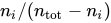 |
mol/mol | ppm, ppb, ppt |
| mass fraction | |
 |
kg/kg | ppm, ppb, ppt |
| mass ratio | |
 |
kg/kg | ppm, ppb, ppt |
| volume fraction |  |
 |
m3/m3 | ppm, ppb, ppt |
Sources and credits
This article is adapted from the Wikipedia article “Concentration”, written by its contributors and licensed under CC BY-SA 4.0. Fathomly has changed the layout, removed citation markers, navigation and maintenance notices, and adjusted punctuation. This adapted version is shared under the same license. For references, see the original article.
Images, from Wikimedia Commons:
- Dilution-concentration simple example.jpg by en:User:FirstPrinciples, Public domain
Fathomly is not affiliated with or endorsed by the Wikimedia Foundation. Spotted a problem? Tell us.
