Diagonal intersection
Diagonal intersection is a term used in mathematics, especially in set theory.
If 
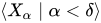

is defined to be
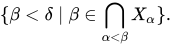
That is, an ordinal 

![\displaystyle \bigcap _{\alpha <\delta }([0,\alpha ]\cup X_{\alpha }),](https://wikimedia.org/api/rest_v1/media/math/render/svg/f6316e249339d97a2d13066c9d9f1d66a7b5259f)
where the closed interval from 0 to 
01Relationship to the Nonstationary Ideal
For κ an uncountable regular cardinal, in the Boolean algebra P(κ)/INS where INS is the nonstationary ideal (the ideal dual to the club filter), the diagonal intersection of a κ-sized family of subsets of κ does not depend on the enumeration. That is to say, if one enumeration gives the diagonal intersection X1 and another gives X2, then there is a club C so that X1 ∩ C = X2 ∩ C.
A set Y is a lower bound of F in P(κ)/INS only when for any S ∈ F there is a club C so that Y ∩ C ⊆ S. The diagonal intersection ΔF of F plays the role of greatest lower bound of F, meaning that Y is a lower bound of F if and only if there is a club C so that Y ∩ C ⊆ ΔF.
This makes the algebra P(κ)/INS a κ+-complete Boolean algebra, when equipped with diagonal intersections.
Sources and credits
This article is adapted from the Wikipedia article “Diagonal intersection”, written by its contributors and licensed under CC BY-SA 4.0. Fathomly has changed the layout, removed citation markers, navigation and maintenance notices, and adjusted punctuation. This adapted version is shared under the same license. For references, see the original article.
Fathomly is not affiliated with or endorsed by the Wikimedia Foundation. Spotted a problem? Tell us.