Derived scheme
In algebraic geometry, a derived scheme is a homotopy-theoretic generalization of a scheme in which classical commutative rings are replaced with derived versions such as differential graded algebras, commutative simplicial rings, or commutative ring spectra.
From the functor of points point-of-view, a derived scheme is a sheaf X on the category of simplicial commutative rings which admits an open affine covering 
From the locally ringed space point-of-view, a derived scheme is a pair 


A derived stack is a stacky generalization of a derived scheme.
01Differential graded scheme
Over a field of characteristic zero, the theory is closely related to that of a differential graded scheme. By definition, a differential graded scheme is obtained by gluing affine differential graded schemes, with respect to étale topology. It was introduced by Maxim Kontsevich "as the first approach to derived algebraic geometry" and was developed further by Mikhail Kapranov and Ionut Ciocan-Fontanine.
Connection with differential graded rings and examples
Just as affine algebraic geometry is equivalent (in categorical sense) to the theory of commutative rings (commonly called commutative algebra), affine derived algebraic geometry over characteristic zero is equivalent to the theory of commutative differential graded rings. One of the main example of derived schemes comes from the derived intersection of subschemes of a scheme, giving the Koszul complex. For example, let ![f_{1},\ldots ,f_{k}\in \mathbb {C} [x_{1},\ldots ,x_{n}]=R](https://wikimedia.org/api/rest_v1/media/math/render/svg/11b1469c2a6de7937198cfa4a13be2776d951058)

where

is the étale spectrum. Since we can construct a resolution
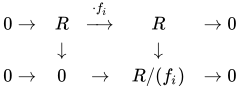
the derived ring 

![[-1,0]](https://wikimedia.org/api/rest_v1/media/math/render/svg/5a19442d946499667f5bd3ddf8478ca48a0ec38a)
![\operatorname {Proj} \left({\frac {\mathbb {Z} [x_{0},\ldots ,x_{n}]}{(f_{1},\ldots ,f_{k})}}\right)](https://wikimedia.org/api/rest_v1/media/math/render/svg/614235ebb6826884b9c443b0f9e095e4bda5f9a6)
where 

![{\mathcal {E}}^{\bullet }=[{\mathcal {O}}(-d_{1})\oplus \cdots \oplus {\mathcal {O}}(-d_{k})\xrightarrow {(\cdot f_{1},\ldots ,\cdot f_{k})} {\mathcal {O}}]](https://wikimedia.org/api/rest_v1/media/math/render/svg/98043c891007cd115962a51f70333d5ea9d0fe2d)
with amplitude
02Cotangent complex
Construction
Let 


- The underlying graded algebra
is a polynomial algebra over
- There exists a filtration
on the indexing set
where
and
for any
.
![A_{\bullet }[\{x_{i}\}_{i\in I}]](https://wikimedia.org/api/rest_v1/media/math/render/svg/292bb9173379dca94d8bec92a0c61b6fb094c74f)
It turns out that every 


Many examples can be constructed by taking the algebra 


Examples
The cotangent complex of a hypersurface 


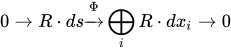
where 

![R^{\bullet }={\frac {\mathbb {C} [x_{1},\ldots ,x_{n}]}{(f_{1})}}\otimes _{\mathbb {C} [x_{1},\ldots ,x_{n}]}^{\mathbf {L} }\cdots \otimes _{\mathbb {C} [x_{1},\ldots ,x_{n}]}^{\mathbf {L} }{\frac {\mathbb {C} [x_{1},\ldots ,x_{n}]}{(f_{k})}}](https://wikimedia.org/api/rest_v1/media/math/render/svg/dffb650eb877b02affb062c1b2bf6d5140cc0794)
is quasi-isomorphic to the complex
![{\frac {\mathbb {C} [x_{1},\ldots ,x_{n}]}{(f_{1},\ldots ,f_{k})}}[+0].](https://wikimedia.org/api/rest_v1/media/math/render/svg/5704c23b8bc6302665e69cc4a5d30a772786b486)
This implies we can construct the cotangent complex of the derived ring 

Remarks
Please note that the cotangent complex in the context of derived geometry differs from the cotangent complex of classical schemes. Namely, if there was a singularity in the hypersurface defined by 
03Tangent complexes
Polynomial functions
Given a polynomial function 
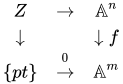
where the bottom arrow is the inclusion of a point at the origin. Then, the derived scheme 

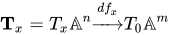
where the complex is of amplitude 

Stack quotients
Given a stack ![[X/G]](https://wikimedia.org/api/rest_v1/media/math/render/svg/6c10708eac95ed8fcce0dd132f18c6d844536ebf)

If the morphism is not injective, the 
![{\mathfrak {g}}[+1]](https://wikimedia.org/api/rest_v1/media/math/render/svg/dc4e9aac7fdf244f3066b9215056d33ee51669ba)
04Derived schemes in complex Morse theory
Derived schemes can be used for analyzing topological properties of affine varieties. For example, consider a smooth affine variety 


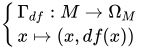
Then, we can take the derived pullback diagram
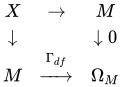
where
Example
Consider the affine variety
![M=\operatorname {Spec} (\mathbb {C} [x,y])](https://wikimedia.org/api/rest_v1/media/math/render/svg/a95d279d78570a4a34442e7b2cedd55fab0b8df5)
and the regular function given by 

where we treat the last two coordinates as 
![{\textbf {RSpec}}\left({\frac {\mathbb {C} [x,y,dx,dy]}{(dx,dy)}}\otimes _{\mathbb {C} [x,y,dx,dy]}^{\mathbf {L} }{\frac {\mathbb {C} [x,y,dx,dy]}{(2x-dx,3y^{2}-dy)}}\right).](https://wikimedia.org/api/rest_v1/media/math/render/svg/76e77fe9750a8c4ae3947a8e927e5fc7332e3f9d)
Note that since the left term in the derived intersection is a complete intersection, we can compute a complex representing the derived ring as
![K_{dx,dy}^{\bullet }(\mathbb {C} [x,y,dx,dy])\otimes _{\mathbb {C} [x,y,dx,dy]}{\frac {\mathbb {C} [x,y,dx,dy]}{(2-dx,3y^{2}-dy)}}](https://wikimedia.org/api/rest_v1/media/math/render/svg/41ac2da7deb2d41bf68ffeae3343f33c0f922ae4)
where ![K_{dx,dy}^{\bullet }(\mathbb {C} [x,y,dx,dy])](https://wikimedia.org/api/rest_v1/media/math/render/svg/ebb7b7a011a1f67835d64f32cd22cfb963c2bd66)
05Derived critical locus
Consider a smooth function 


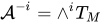
and the differential 

Example
For example, if
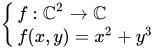
we have the complex

representing the derived enhancement of
Sources and credits
This article is adapted from the Wikipedia article “Derived scheme”, written by its contributors and licensed under CC BY-SA 4.0. Fathomly has changed the layout, removed citation markers, navigation and maintenance notices, and adjusted punctuation. This adapted version is shared under the same license. For references, see the original article.
Fathomly is not affiliated with or endorsed by the Wikimedia Foundation. Spotted a problem? Tell us.