Density on a manifold
Section of a certain line bundle
In mathematics, and specifically differential geometry, a density is a spatially varying quantity on a differentiable manifold that can be integrated in an intrinsic manner. Abstractly, a density is a section of a certain line bundle, called the density bundle. An element of the density bundle at x is a function that assigns a volume for the parallelotope spanned by the n given tangent vectors at x.
From the operational point of view, a density is a collection of functions on coordinate charts which become multiplied by the absolute value of the Jacobian determinant in the change of coordinates. Densities can be generalized into s-densities, whose coordinate representations become multiplied by the s-th power of the absolute value of the jacobian determinant. On an oriented manifold, 1-densities can be canonically identified with the n-forms on M. On non-orientable manifolds this identification cannot be made, since the density bundle is the tensor product of the orientation bundle of M and the n-th exterior product bundle of T∗M (see pseudotensor).
01Motivation (densities in vector spaces)
In general, there does not exist a natural concept of a "volume" for a parallelotope generated by vectors v1, ..., vn in a n-dimensional vector space V. However, if one wishes to define a function μ : V × ... × V → R that assigns a volume for any such parallelotope, it should satisfy the following properties:
- If any of the vectors vk is multiplied by λ ∈ R, the volume should be multiplied by |λ|.
- If any linear combination of the vectors v1, ..., vj−1, vj+1, ..., vn is added to the vector vj, the volume should stay invariant.
These conditions are equivalent to the statement that μ is given by a translation-invariant measure on V, and they can be rephrased as

Any such mapping μ : V × ... × V → R is called a density on the vector space V. Note that if (v1, ..., vn) is any basis for V, then fixing μ(v1, ..., vn) will fix μ entirely; it follows that the set Vol(V) of all densities on V forms a one-dimensional vector space. Any n-form ω on V defines a density |ω| on V by

Orientations on a vector space
The set Or(V) of all functions o : V × ... × V → R that satisfy

if 

forms a one-dimensional vector space, and an orientation on V is one of the two elements o ∈ Or(V) such that |o(v1, ..., vn)| = 1 for any linearly independent v1, ..., vn. Any non-zero n-form ω on V defines an orientation o ∈ Or(V) such that

and vice versa, any o ∈ Or(V) and any density μ ∈ Vol(V) define an n-form ω on V by

In terms of tensor product spaces,

s-densities on a vector space
The s-densities on V are functions μ : V × ... × V → R such that

Just like densities, s-densities form a one-dimensional vector space Vols(V), and any n-form ω on V defines an s-density |ω|s on V by

The product of s1- and s2-densities μ1 and μ2 form an (s1+s2)-density μ by

In terms of tensor product spaces this fact can be stated as

02Definition
Formally, the s-density bundle Vols(M) of a differentiable manifold M is obtained by an associated bundle construction, intertwining the one-dimensional group representation

of the general linear group with the frame bundle of M.
The resulting line bundle is known as the bundle of s-densities, and is denoted by

A 1-density is also referred to simply as a density.
More generally, the associated bundle construction also allows densities to be constructed from any vector bundle E on M.
In detail, if (Uα,φα) is an atlas of coordinate charts on M, then there is associated a local trivialization of


subordinate to the open cover Uα such that the associated GL(1)-cocycle satisfies

03Integration
Densities play a significant role in the theory of integration on manifolds. Indeed, the definition of a density is motivated by how a measure dx changes under a change of coordinates (Folland 1999, Section 11.4, pp. 361-362).
Given a 1-density ƒ supported in a coordinate chart Uα, the integral is defined by
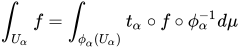
where the latter integral is with respect to the Lebesgue measure on Rn. The transformation law for 1-densities together with the Jacobian change of variables ensures compatibility on the overlaps of different coordinate charts, and so the integral of a general compactly supported 1-density can be defined by a partition of unity argument. Thus 1-densities are a generalization of the notion of a volume form that does not necessarily require the manifold to be oriented or even orientable. One can more generally develop a general theory of Radon measures as distributional sections of 
The set of 1/p-densities such that 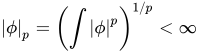

04Conventions
In some areas, particularly conformal geometry, a different weighting convention is used: the bundle of s-densities is instead associated with the character

With this convention, for instance, one integrates n-densities (rather than 1-densities). Also in these conventions, a conformal metric is identified with a tensor density of weight 2.
05Properties
- The dual vector bundle of
is
.
- Tensor densities are sections of the tensor product of a density bundle with a tensor bundle.
Sources and credits
This article is adapted from the Wikipedia article “Density on a manifold”, written by its contributors and licensed under CC BY-SA 4.0. Fathomly has changed the layout, removed citation markers, navigation and maintenance notices, and adjusted punctuation. This adapted version is shared under the same license. For references, see the original article.
Fathomly is not affiliated with or endorsed by the Wikimedia Foundation. Spotted a problem? Tell us.