Deep image prior
Deep image prior is a type of convolutional neural network used to enhance a given image with no prior training data other than the image itself. A neural network is randomly initialized and used as prior to solve inverse problems such as noise reduction, super-resolution, and inpainting. Image statistics are captured by the structure of a convolutional image generator rather than by any previously learned capabilities.
01Method
Background
Inverse problems such as noise reduction, super-resolution, and inpainting can be formulated as the optimization task 


Deep neural networks learn a generator/decoder 

The image corruption method used to generate
Specifics
In this approach, the 




The minimizer 

Overfitting
A parameter θ may be used to recover any image, including its noise. However, the network is reluctant to pick up noise because it contains high impedance while useful signal offers low impedance. This results in the θ parameter approaching a good-looking local optimum so long as the number of iterations in the optimization process remains low enough not to overfit data.
Deep Neural Network Model
Typically, the deep neural network model for deep image prior uses a U-Net like model without the skip connections that connect the encoder blocks with the decoder blocks. The authors in their paper mention that "Our findings here (and in other similar comparisons) seem to suggest that having deeper architecture is beneficial, and that having skip-connections that work so well for recognition tasks (such as semantic segmentation) is highly detrimental."
02Applications
Denoising
The principle of denoising is to recover an image 

The quadratic energy function 

Super-resolution
Super-resolution is used to generate a higher resolution version of image x. The data term is set to 
Inpainting
Inpainting is used to reconstruct a missing area in an image 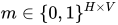


The intuition behind this is that the loss is computed only on the known pixels in the image, and the network is going to learn enough about the image to fill in unknown parts of the image even though the computed loss doesn't include those pixels. This strategy is used to remove image watermarks by treating the watermark as missing pixels in the image.
Flash-no-flash reconstruction
This approach may be extended to multiple images. A straightforward example mentioned by the author is the reconstruction of an image to obtain natural light and clarity from a flash-no-flash pair. Video reconstruction is possible but it requires optimizations to take into account the spatial differences.
03Implementations
- A reference implementation rewritten in Python 3.6 with the PyTorch 0.4.0 library was released by the author under the Apache 2.0 license: deep-image-prior
- A TensorFlow-based implementation written in Python 2 and released under the CC-SA 3.0 license: deep-image-prior-tensorflow
- A Keras-based implementation written in Python 2 and released under the GPLv3: machine_learning_denoising
04Example
See Astronomy Picture of the Day (APOD) of 2024-02-18
Sources and credits
This article is adapted from the Wikipedia article “Deep image prior”, written by its contributors and licensed under CC BY-SA 4.0. Fathomly has changed the layout, removed citation markers, navigation and maintenance notices, and adjusted punctuation. This adapted version is shared under the same license. For references, see the original article.
Fathomly is not affiliated with or endorsed by the Wikimedia Foundation. Spotted a problem? Tell us.