Cyclic code
Type of block code

In coding theory, a cyclic code is a block code, where the circular shifts of each codeword gives another word that belongs to the code. They are error-correcting codes that have algebraic properties that are convenient for efficient error detection and correction.
01Definition
Let be a linear code over a finite field (also called Galois field)
of block length
.
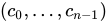
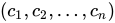
is called a cyclic code if, for every codeword
from
, the word
in
obtained by a cyclic right shift of components is again a codeword. Because one cyclic right shift is equal to
cyclic left shifts, a cyclic code may also be defined via cyclic left shifts. Therefore, the linear code
is cyclic precisely when it is invariant under all cyclic shifts.
Cyclic codes have some additional structural constraint on the codes. They are based on Galois fields and because of their structural properties they are very useful for error controls. Their structure is strongly related to Galois fields because of which the encoding and decoding algorithms for cyclic codes are computationally efficient.
02Algebraic structure
Cyclic codes can be linked to ideals in certain rings. Let be a quotient of a polynomial ring over the finite field
. Identify the elements of the cyclic code
with polynomials in
such that
maps to the polynomial
: thus multiplication by
corresponds to a cyclic shift. Then
is an ideal in
, and hence principal, since
is a principal ideal ring. The ideal is generated by the unique monic element in
of minimum degree, the generator polynomial
.
This must be a divisor of
. It follows that every cyclic code is a polynomial code.
If the generator polynomial
has degree
then the rank of the code
is
.
If is a cyclic code, the dual code
is also a cyclic code. The generator polynomial
for
is also called the parity-check polynomial or simply check polynomial for
. It can also be shown that
, where
denotes the reciprocal polynomial of
.
The idempotent of is a codeword
such that
(that is,
is an idempotent element of
) and
is an identity for the code, that is
for every codeword
. If
and
are coprime such a word always exists and is unique; it is a generator of the code.
An irreducible code is a cyclic code in which the code, as an ideal is irreducible, i.e. is minimal in , so that its check polynomial is an irreducible polynomial.
03Examples
For example, if and
, the set of codewords contained in the cyclic code generated by
is precisely
This code corresponds to the ideal in generated by
.
The polynomial is irreducible in the polynomial ring, and hence the code is an irreducible code.
The idempotent of this code is the polynomial , corresponding to the codeword
.
Trivial examples
Trivial examples of cyclic codes are itself and the code containing only the zero codeword. These correspond to generators
and
respectively: these two polynomials must always be factors of
.
Over the parity bit code, consisting of all words of even weight, corresponds to generator
. Again over
this must always be a factor of
.
Other examples
Many types of commonly used error-correcting codes can be represented as cyclic codes, including BCH codes, Reed-Solomon codes, and some classes of low-density parity-check codes defined from finite geometries.
04For correcting errors
Cyclic codes can be used to correct errors, like Hamming codes as cyclic codes can be used for correcting single error. Likewise, they are also used to correct double errors and burst errors. All types of error corrections are covered briefly in the further subsections.
The (7,4) Hamming code has a generator polynomial . This polynomial has a zero in Galois extension field

at the primitive element
, and all codewords satisfy
. Cyclic codes can also be used to correct double errors over the field
. Blocklength will be
equal to
and primitive elements
and
as zeros in the
because we are considering the case of two errors here, so each will represent one error.
The received word is a polynomial of degree given as

where can have at most two nonzero coefficients corresponding to 2 errors.
We define the syndrome polynomial, as the remainder of polynomial

when divided by the generator polynomial
i.e.
as
.
For correcting two errors
Let the field elements and
be the two error location numbers. If only one error occurs then
is equal to zero and if none occurs both are zero.
Let and
.
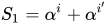
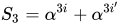
These field elements are called "syndromes". Now because is zero at primitive elements
and
, so we can write
and
. If say two errors occur, then
and
.
And these two can be considered as two pair of equations in with two unknowns and hence we can write

and
.
Hence if the two pair of nonlinear equations can be solved cyclic codes can used to correct two errors.
05Hamming code
The Hamming(7,4) code may be written as a cyclic code over GF(2) with generator . In fact, any binary Hamming code of the form Ham(r, 2) is equivalent to a cyclic code, and any Hamming code of the form Ham(r,q) with r and q-1 relatively prime is also equivalent to a cyclic code. Given a Hamming code of the form Ham(r,2) with
, the set of even codewords forms a cyclic
-code.
Hamming code for correcting single errors
A code whose minimum distance is at least 3, have a check matrix all of whose columns are distinct and non zero. If a check matrix for a binary code has rows, then each column is an
-bit binary number. There are
possible columns. Therefore, if a check matrix of a binary code with
at least 3 has
rows, then it can only have
columns, not more than that. This defines a
code, called Hamming code.
It is easy to define Hamming codes for large alphabets of size . We need to define one
matrix with linearly independent columns. For any word of size
there will be columns who are multiples of each other. So, to get linear independence all non zero
-tuples with one as a top most non zero element will be chosen as columns. Then two columns will never be linearly dependent because three columns could be linearly dependent with the minimum distance of the code as 3.
So, there are nonzero columns with one as top most non zero element. Therefore, a Hamming code is a
code.
Now, for cyclic codes, Let be primitive element in
, and let
. Then
and thus
is a zero of the polynomial
and is a generator polynomial for the cyclic code of block length
.
But for ,
. And the received word is a polynomial of degree
given as
where, or
where
represents the error locations.
But we can also use as an element of
to index error location. Because
, we have
and all powers of
from
to
are distinct. Therefore, we can easily determine error location
from
unless
which represents no error. So, a Hamming code is a single error correcting code over
with
and
.
06For correcting burst errors
From Hamming distance concept, a code with minimum distance can correct any
errors. But in many channels error pattern is not very arbitrary, it occurs within very short segment of the message. Such kind of errors are called burst errors. So, for correcting such errors we will get a more efficient code of higher rate because of the less constraints. Cyclic codes are used for correcting burst error. In fact, cyclic codes can also correct cyclic burst errors along with burst errors. Cyclic burst errors are defined as
A cyclic burst of length is a vector whose nonzero components are among
(cyclically) consecutive components, the first and the last of which are nonzero.
In polynomial form cyclic burst of length can be described as

with
as a polynomial of degree
with nonzero coefficient
. Here
defines the pattern and
defines the starting point of error. Length of the pattern is given by deg
. The syndrome polynomial is unique for each pattern and is given by
A linear block code that corrects all burst errors of length or less must have at least
check symbols. Proof: Because any linear code that can correct burst pattern of length
or less cannot have a burst of length
or less as a codeword because if it did then a burst of length
could change the codeword to burst pattern of length
, which also could be obtained by making a burst error of length
in all zero codeword. Now, any two vectors that are non zero in the first
components must be from different co-sets of an array to avoid their difference being a codeword of bursts of length
. Therefore, number of such co-sets are equal to number of such vectors which are
. Hence at least
co-sets and hence at least
check symbol.
This property is also known as Rieger bound and it is similar to the Singleton bound for random error correcting.
Fire codes as cyclic bounds
In 1959, Philip Fire presented a construction of cyclic codes generated by a product of a binomial and a primitive polynomial. The binomial has the form for some positive odd integer
. Fire code is a cyclic burst error correcting code over
with the generator polynomial
where is a prime polynomial with degree
not smaller than
and
does not divide
. Block length of the fire code is the smallest integer
such that
divides
.
A fire code can correct all burst errors of length t or less if no two bursts and
appear in the same co-set. This can be proved by contradiction. Suppose there are two distinct nonzero bursts
and
of length
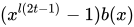
or less and are in the same co-set of the code. So, their difference is a codeword. As the difference is a multiple of
it is also a multiple of
. Therefore,
.
This shows that is a multiple of
, So
for some . Now, as
is less than
and
is less than
so
is a codeword. Therefore,
.
Since degree is less than degree of
,
cannot divide
. If
is not zero, then
also cannot divide
as
is less than
and by definition of
,
divides
for no
smaller than
. Therefore
and
equals to zero. That means both that both the bursts are same, contrary to assumption.
Fire codes are the best single burst correcting codes with high rate and they are constructed analytically. They are of very high rate and when and
are equal, redundancy is least and is equal to
. By using multiple fire codes longer burst errors can also be corrected.
For error detection cyclic codes are widely used and are called cyclic redundancy codes.
07On Fourier transform
Applications of Fourier transform are widespread in signal processing. But their applications are not limited to the complex fields only; Fourier transforms also exist in the Galois field . Cyclic codes using Fourier transform can be described in a setting closer to the signal processing.
Fourier transform over finite fields
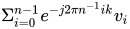
The discrete Fourier transform of vector is given by a vector

where,
=
where,
where exp() is an
th root of unity. Similarly in the finite field
th root of unity is element
of order
. Therefore
If is a vector over
, and
be an element of
of order
, then Fourier transform of the vector
is the vector
and components are given by
=
where,
Here is time index,
is frequency and
is the spectrum. One important difference between Fourier transform in complex field and Galois field is that complex field
exists for every value of
while in Galois field
exists only if
divides
. In case of extension fields, there will be a Fourier transform in the extension field
if
divides
for some
.
In Galois field time domain vector
is over the field
but the spectrum
may be over the extension field
.
Spectral description
Any codeword of cyclic code of blocklength can be represented by a polynomial
of degree at most
. Its encoder can be written as
. Therefore, in frequency domain encoder can be written as
. Here codeword spectrum
has a value in
but all the components in the time domain are from
. As the data spectrum
is arbitrary, the role of
is to specify those
where
will be zero.
Thus, cyclic codes can also be defined as
Given a set of spectral indices, , whose elements are called check frequencies, the cyclic code

is the set of words over
whose spectrum is zero in the components indexed by
. Any such spectrum
will have components of the form
.
So, cyclic codes are vectors in the field and the spectrum given by its inverse fourier transform is over the field
and are constrained to be zero at certain components. But every spectrum in the field
and zero at certain components may not have inverse transforms with components in the field
. Such spectrum can not be used as cyclic codes.
Following are the few bounds on the spectrum of cyclic codes.
BCH bound
If be a factor of
for some
. The only vector in
of weight
or less that has
consecutive components of its spectrum equal to zero is all-zero vector.
Hartmann-Tzeng bound
If be a factor of
for some
, and
an integer that is coprime with
. The only vector
in
of weight
or less whose spectral
components
equal zero for
, where
and
, is the all zero vector.
Roos bound
If be a factor of
for some
and
. The only vector in
of weight
or less whose spectral components
equal to zero for
, where
and
takes at least
values in the range
, is the all-zero vector.
Quadratic residue codes
When the prime is a quadratic residue modulo the prime
there is a quadratic residue code which is a cyclic code of length
, dimension
and minimum weight at least
over
.
08Generalizations
Constacyclic codes
A constacyclic code is a linear code with the property that for some constant if
is a codeword, then so is
. A negacyclic code is a constacyclic code with
.
Quasi-cyclic code
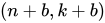
A quasi-cyclic code (QC code) has the property that for some dividing
, any cyclic shift of a codeword by
places is again a codeword. That is, for some constant
, if
is a codeword, then so is
, where all subscripts are reduced mod
. Such a code is known as an
-QC code. A double circulant code is a quasi-cyclic code of even length with
.
Shortened cyclic codes
An linear code is called a shortened cyclic code if it can be obtained by deleting
positions from an
cyclic code. Code of this form are not generally cyclic.
In shortened codes, information symbols are deleted to obtain a desired block length smaller than the original block length. While deleting the first symbols is a common approach, in principle any set of information symbols can be deleted. Any cyclic code can be converted to a quasi-cyclic code by dropping every
-th symbol, where
is a factor of
. If the dropped symbols are not check symbols, this cyclic code is also a shortened cyclic code.
Other generalizations
Quasi-twisted codes (QT codes) combine the properties of constacyclic and quasi-cyclic codes, with the shift occurring by places and with a multiplier of
. That is, for some constants
and
, if
is a codeword, then so is
, where all subscripts are reduced mod
. Multi-twisted codes are further generalizations of QT codes, which join multiple QT codes end to end.
Sources and credits
This article is adapted from the Wikipedia article “Cyclic code”, written by its contributors and licensed under CC BY-SA 4.0. Fathomly has changed the layout, removed citation markers, navigation and maintenance notices, and adjusted punctuation. This adapted version is shared under the same license. For references, see the original article.
Images, from Wikimedia Commons:
- Rotate right.svg by en:User:Cburnett, CC BY-SA 3.0
Fathomly is not affiliated with or endorsed by the Wikimedia Foundation. Spotted a problem? Tell us.