Cramér's conjecture
Estimation in number theory
In number theory, Cramér's conjecture, formulated by the Swedish mathematician Harald Cramér in 1936, is an estimate for the size of gaps between consecutive prime numbers: intuitively, that gaps between consecutive primes are always small, and the conjecture quantifies asymptotically just how small they must be. It states that

where pn denotes the nth prime number, O is big O notation, and "log" is the natural logarithm. While this is the statement explicitly conjectured by Cramér, his heuristic actually supports the stronger statement
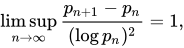
and sometimes this formulation is called Cramér's conjecture. However, this stronger version is not supported by more accurate heuristic models, which nevertheless support the first version of Cramér's conjecture.
The strongest form of all, which was never claimed by Cramér but is the one used in experimental verification computations and the plot in this article, is simply

which is the same as Mohebbi's conjecture for large values of 
.
None of the three forms have yet been proven or disproven.
01Conditional proven results on prime gaps
Cramér gave a conditional proof of the much weaker statement that

on the assumption of the Riemann hypothesis. The best known unconditional upper bound is

due to Baker, Harman, and Pintz.
In the other direction, E. Westzynthius proved in 1931 that prime gaps grow more than logarithmically. That is,
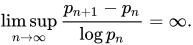
His result was improved by R. A. Rankin, who proved that

Paul Erdős conjectured that the left-hand side of the above formula is infinite, and this was proven in 2014 by Kevin Ford, Ben Green, Sergei Konyagin, and Terence Tao, and independently by James Maynard.
The two approaches were subsequently combined by Ford, Green, Konyagin, Maynard, and Tao, who showed that, infinitely often,

where 
In August 2026, a manuscript listing the OpenAI model GPT-5.6 Sol as its author gave the stronger bound

for infinitely many

where 


Boris Alexeev subsequently released a formalization of the result in the Lean proof assistant. As of August 2026, the result had not appeared in a peer-reviewed publication, although the formalization provided a machine-checkable version of its main prime-gap bound.

02Heuristic justification
Cramér's conjecture is based on a probabilistic model, essentially a heuristic, in which the probability that a number of size x is prime is 1/log x. This is known as the Cramér random model or Cramér model of the primes.
In the Cramér random model,
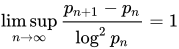
with probability one. However, as pointed out by Andrew Granville, Maier's theorem shows that the Cramér random model does not adequately describe the distribution of primes on short intervals, and a refinement of Cramér's model taking into account divisibility by small primes suggests that the limit should not be 1, but a constant 

- As a result of the work of H. Maier on gaps between consecutive primes, the exact formulation of Cramér's conjecture has been called into question [...] It is still probably true that for every constant
, there is a constant
such that there is a prime between
and
.
Similarly, Robin Visser writes
- In fact, due to the work done by Granville, it is now widely believed that Cramér's conjecture is false. Indeed, there [are] some theorems concerning short intervals between primes, such as Maier's theorem, which contradict Cramér's model.
(internal references removed).
03Related conjectures and heuristics
Daniel Shanks conjectured the following asymptotic equality, stronger than Cramér's conjecture, for record gaps:
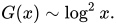
J.H. Cadwell has proposed the formula for the maximal gaps:

Marek Wolf has proposed the formula for the maximal gaps 


where 

.
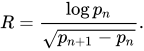
Thomas Nicely has calculated many large prime gaps. He measures the quality of fit to Cramér's conjecture by measuring the ratio
He writes, "For the largest known maximal gaps, 
Sources and credits
This article is adapted from the Wikipedia article “Cramér's conjecture”, written by its contributors and licensed under CC BY-SA 4.0. Fathomly has changed the layout, removed citation markers, navigation and maintenance notices, and adjusted punctuation. This adapted version is shared under the same license. For references, see the original article.
Images, from Wikimedia Commons:
- Primegaps-new.png by Marek Wolf, CC BY-SA 3.0
Fathomly is not affiliated with or endorsed by the Wikimedia Foundation. Spotted a problem? Tell us.
