Costate equation
Optimal control equation
The costate equation is related to the state equation used in optimal control. It is also referred to as auxiliary, adjoint, influence, or multiplier equation. It is stated as a vector of first order differential equations
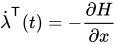
where the right-hand side is the vector of partial derivatives of the negative of the Hamiltonian with respect to the state variables.
01Interpretation
The costate variables 
02Solution
The state equation is subject to an initial condition and is solved forwards in time. The costate equation must satisfy a transversality condition and is solved backwards in time, from the final time towards the beginning. For more details see Pontryagin's maximum principle.
Sources and credits
This article is adapted from the Wikipedia article “Costate equation”, written by its contributors and licensed under CC BY-SA 4.0. Fathomly has changed the layout, removed citation markers, navigation and maintenance notices, and adjusted punctuation. This adapted version is shared under the same license. For references, see the original article.
Fathomly is not affiliated with or endorsed by the Wikimedia Foundation. Spotted a problem? Tell us.