Control variates
Technique for increasing the precision of estimates in Monte Carlo experiments
The control variates method is a variance reduction technique used in Monte Carlo methods. It exploits information about the errors in estimates of known quantities to reduce the error of an estimate of an unknown quantity.
01Underlying principle
Let the unknown parameter of interest be 

![\mathbb {E} \left[m\right]=\mu](https://wikimedia.org/api/rest_v1/media/math/render/svg/a20f602ef5e52ccac3808a48f0a14c600b36fb1c)

![\mathbb {E} \left[t\right]=\tau](https://wikimedia.org/api/rest_v1/media/math/render/svg/1903b64e792a1455fedd92d54d668fa9a23a5967)

is also an unbiased estimator for 


By differentiating the above expression with respect to
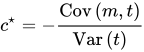
minimizes the variance of
![{\begin{aligned}{\textrm {Var}}\left(m^{\star }\right)&={\textrm {Var}}\left(m\right)-{\frac {\left[{\textrm {Cov}}\left(m,t\right)\right]^{2}}{{\textrm {Var}}\left(t\right)}}\\&=\left(1-\rho _{m,t}^{2}\right){\textrm {Var}}\left(m\right)\end{aligned}}](https://wikimedia.org/api/rest_v1/media/math/render/svg/3399b00e688aae740a79cd98214602547b8f7b51)
where

is the correlation coefficient of 
In the case that 


When the expectation of the control variable, 
02Example
We would like to estimate
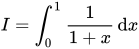
using Monte Carlo integration. This integral is the expected value of 
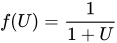
and U follows a uniform distribution [0, 1].
Using a sample of size n denote the points in the sample as 
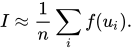
Now we introduce 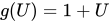
![\mathbb {E} \left[g\left(U\right)\right]=\int _{0}^{1}(1+x)\,\mathrm {d} x={\tfrac {3}{2}}](https://wikimedia.org/api/rest_v1/media/math/render/svg/63e77fbb5d0fec9232e81a7b53bfada99a2cee8e)

Using 

| Estimate | Variance | |
| Classical estimate | 0.69475 | 0.01947 |
| Control variates | 0.69295 | 0.00060 |
The variance was significantly reduced after using the control variates technique. (The exact result is 
Sources and credits
This article is adapted from the Wikipedia article “Control variates”, written by its contributors and licensed under CC BY-SA 4.0. Fathomly has changed the layout, removed citation markers, navigation and maintenance notices, and adjusted punctuation. This adapted version is shared under the same license. For references, see the original article.
Fathomly is not affiliated with or endorsed by the Wikimedia Foundation. Spotted a problem? Tell us.