Consistent heuristic
Type of heuristic in path-finding problems
In the study of path-finding problems in artificial intelligence, a heuristic function is said to be consistent, or monotone, if its estimate is always less than or equal to the estimated distance from any neighbouring vertex to the goal, plus the cost of reaching that neighbour.
Formally, for every node N and each successor P of N, the estimated cost of reaching the goal from N is no greater than the step cost of getting to P plus the estimated cost of reaching the goal from P. That is:
and

where
- h is the consistent heuristic function
- N is any node in the graph
- P is any descendant of N
- G is any goal node
- c(N,P) is the cost of reaching node P from N
Informally, every node i will give an estimate that, accounting for the cost to reach the next node, is always lesser than or equal to the estimate at node i+1.
A consistent heuristic is also admissible, i.e. it never overestimates the cost of reaching the goal (the converse, however, is not always true). Assuming non negative edges, this can be easily proved by induction.
Let 

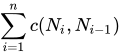
The converse is clearly not true as we can always construct a heuristic that is always below the true cost but is nevertheless inconsistent by, for instance, increasing the heuristic estimate from the farthest node as we get closer and, when the estimate 


01Consequences of monotonicity
Consistent heuristics are called monotone because the estimated final cost of a partial solution, 
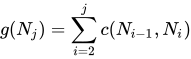


The justification for 
Suppose 


hence 
In the A* search algorithm, using a consistent heuristic means that once a node is expanded, the cost by which it was reached is the lowest possible, under the same conditions that Dijkstra's algorithm requires in solving the shortest path problem (no negative cost edges). In fact, if the search graph is given cost 

With a non-decreasing 


In the unusual event that an admissible heuristic is not consistent, a node will need repeated expansion every time a new best (so-far) cost is achieved for it.
If the given heuristic

as the heuristic value for 

Relation to Local Admissibility
Modifying the consistency condition to h(N)−h(P) ≤ c(N,P) establishes a connection to local admissibility, where the heuristic estimate to a specific node remains less than or equal to the actual step cost. This ensures optimality when selecting local nodes, akin to how admissible heuristics ensure global optimality. By maintaining this property, the search process improves efficiency by making locally optimal decisions that contribute to the globally optimal solution.

Sources and credits
This article is adapted from the Wikipedia article “Consistent heuristic”, written by its contributors and licensed under CC BY-SA 4.0. Fathomly has changed the layout, removed citation markers, navigation and maintenance notices, and adjusted punctuation. This adapted version is shared under the same license. For references, see the original article.
Images, from Wikimedia Commons:
- Heuristics Comparison.png by Johannes Simon, CC BY-SA 4.0
Fathomly is not affiliated with or endorsed by the Wikimedia Foundation. Spotted a problem? Tell us.