Conservativity
Proposed linguistic universal
In formal semantics conservativity is a proposed linguistic universal which states that any determiner 

- Every aardvark bites.
- Every aardvark is an aardvark that bites.


Conceptually, conservativity can be understood as saying that the elements of 

Conservativity is significant to semantic theory because there are many logically possible determiners which are not attested as denotations of natural language expressions. For instance, consider the imaginary determiner 
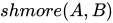


Some potential counterexamples to conservativity have been observed, notably, the English expression "only". This expression has been argued to not be a determiner since it can stack with bona fide determiners and can combine with non-nominal constituents such as verb phrases.
- Only some aardvarks bite.
- This aardvark will only [VP bite playfully.]
Different analyses have treated conservativity as a constraint on the lexicon, a structural constraint arising from the architecture of the syntax-semantics interface, as well as constraint on learnability.
Sources and credits
This article is adapted from the Wikipedia article “Conservativity”, written by its contributors and licensed under CC BY-SA 4.0. Fathomly has changed the layout, removed citation markers, navigation and maintenance notices, and adjusted punctuation. This adapted version is shared under the same license. For references, see the original article.
Fathomly is not affiliated with or endorsed by the Wikimedia Foundation. Spotted a problem? Tell us.