Conic constant
Parameter describing conic sections

In geometry, the conic constant (or Schwarzschild constant, after Karl Schwarzschild) is a quantity describing conic sections, and is represented by the letter K. The constant is given by 
The equation for a conic section with apex at the origin and tangent to the y axis is

or alternately
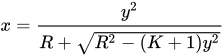
where R is the radius of curvature at x = 0.
This formulation is used in geometric optics to specify oblate elliptical (K > 0), spherical (K = 0), prolate elliptical (0 > K > −1), parabolic (K = −1), and hyperbolic (K < −1) lens and mirror surfaces. When the paraxial approximation is valid, the optical surface can be treated as a spherical surface with the same radius.
Sources and credits
This article is adapted from the Wikipedia article “Conic constant”, written by its contributors and licensed under CC BY-SA 4.0. Fathomly has changed the layout, removed citation markers, navigation and maintenance notices, and adjusted punctuation. This adapted version is shared under the same license. For references, see the original article.
Images, from Wikimedia Commons:
- Conic constant.svg by 0x30114 at English Wikipedia, CC BY-SA 3.0
Fathomly is not affiliated with or endorsed by the Wikimedia Foundation. Spotted a problem? Tell us.