Conditional variance
Variance of a random variable given value of other variables
In probability theory and statistics, a conditional variance is the variance of a random variable given the value(s) of one or more other variables. Particularly in econometrics, the conditional variance is also known as the scedastic function or skedastic function. Conditional variances are important parts of autoregressive conditional heteroskedasticity (ARCH) models.
01Definition
The conditional variance of a random variable Y given another random variable X is

The conditional variance tells us how much variance is left if we use 

02Explanation, relation to least-squares
Recall that variance is the expected squared deviation between a random variable (say, Y) and its expected value.
The expected value can be thought of as a reasonable prediction of the outcomes of the random experiment (in particular, the expected value is the best constant prediction when predictions are assessed by expected squared prediction error). Thus, one interpretation of variance is that it gives the smallest possible expected squared prediction error. If we have the knowledge of another random variable (X) that we can use to predict Y, we can potentially use this knowledge to reduce the expected squared error. As it turns out, the best prediction of Y given X is the conditional expectation. In particular, for any 
![{\begin{aligned}\operatorname {E} [(Y-f(X))^{2}]&=\operatorname {E} [(Y-\operatorname {E} (Y|X)\,\,+\,\,\operatorname {E} (Y|X)-f(X))^{2}]\\&=\operatorname {E} [\operatorname {E} \{(Y-\operatorname {E} (Y|X)\,\,+\,\,\operatorname {E} (Y|X)-f(X))^{2}|X\}]\\&=\operatorname {E} [\operatorname {Var} (Y|X)]+\operatorname {E} [(\operatorname {E} (Y|X)-f(X))^{2}]\,.\end{aligned}}](https://wikimedia.org/api/rest_v1/media/math/render/svg/53a7661b7f329003e656ea07186194e23e37ec09)
By selecting 
03Special cases, variations
Conditioning on discrete random variables
When X takes on countable many values 


where recall that 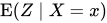

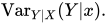
Note that here
The connection of this definition to 



Definition using conditional distributions
The "conditional expectation of Y given X=x" can also be defined more generally using the conditional distribution of Y given X (this exists in this case, as both here X and Y are real-valued).
In particular, letting 
![P_{Y|X}:{\mathcal {B}}\times \mathbb {R} \to [0,1]](https://wikimedia.org/api/rest_v1/media/math/render/svg/88ddda966175068cbdbbc030c735007ba9e68e13)


This can, of course, be specialized to when Y is discrete itself (replacing the integrals with sums), and also when the conditional density of Y given X=x with respect to some underlying distribution exists.
04Components of variance
The law of total variance says

In words: the variance of Y is the sum of the expected conditional variance of Y given X and the variance of the conditional expectation of Y given X. The first term captures the variation left after "using X to predict Y", while the second term captures the variation due to the mean of the prediction of Y due to the randomness of X.
Sources and credits
This article is adapted from the Wikipedia article “Conditional variance”, written by its contributors and licensed under CC BY-SA 4.0. Fathomly has changed the layout, removed citation markers, navigation and maintenance notices, and adjusted punctuation. This adapted version is shared under the same license. For references, see the original article.
Fathomly is not affiliated with or endorsed by the Wikimedia Foundation. Spotted a problem? Tell us.