Concurrence (quantum computing)
State invariant involving qubits
In quantum information science, the concurrence is a state invariant involving qubits.
01Definition
The concurrence is an entanglement monotone (a way of measuring entanglement) defined for a mixed state of two qubits as:

in which 
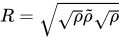
with

the spin-flipped state of 


A generalized version of concurrence for multiparticle pure states in arbitrary dimensions (including the case of continuous-variables in infinite dimensions) is defined as:

in which 

02Other formulations
Alternatively, the 

03Properties
For pure states, the square of the concurrence (also known as the tangle) is a polynomial 
For the tangle, there is monogamy of entanglement, that is, the tangle of a qubit with the rest of the system cannot ever exceed the sum of the tangles of qubit pairs which it is part of.
Sources and credits
This article is adapted from the Wikipedia article “Concurrence (quantum computing)”, written by its contributors and licensed under CC BY-SA 4.0. Fathomly has changed the layout, removed citation markers, navigation and maintenance notices, and adjusted punctuation. This adapted version is shared under the same license. For references, see the original article.
Fathomly is not affiliated with or endorsed by the Wikimedia Foundation. Spotted a problem? Tell us.