Compound matrix
Matrix whose entries are all minors of another matrix
In linear algebra, a branch of mathematics, a (multiplicative) compound matrix is a matrix whose entries are all minors, of a given size, of another matrix. Compound matrices are closely related to exterior algebras, and their computation appears in a wide array of problems, such as in the analysis of nonlinear time-varying dynamical systems and generalizations of positive systems, cooperative systems and contracting systems.
01Definition
Let A be an m × n matrix with real or complex entries. If I is a subset of size r of {1, ..., m} and J is a subset of size s of {1, ..., n}, then the (I, J )-submatrix of A, written AI, J , is the submatrix formed from A by retaining only those rows indexed by I and those columns indexed by J. If r = s, then det AI, J is the (I, J )-minor of A.
The r th compound matrix of A is a matrix, denoted Cr (A), is defined as follows. If r > min(m, n), then Cr (A) is the unique 0 × 0 matrix. Otherwise, Cr (A) has size 
In some applications of compound matrices, the precise ordering of the rows and columns is unimportant. For this reason, some authors do not specify how the rows and columns are to be ordered.
For example, consider the matrix
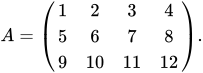
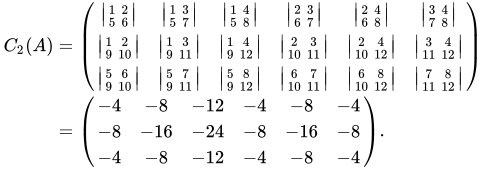
The rows are indexed by {1, 2, 3} and the columns by {1, 2, 3, 4}. Therefore, the rows of C2 (A) are indexed by the sets

and the columns are indexed by

Using absolute value bars to denote determinants, the second compound matrix is

02Properties
Let c be a scalar, A be an m × n matrix, and B be an n × p matrix. For k a positive integer, let Ik denote the k × k identity matrix. The transpose of a matrix M will be written MT, and the conjugate transpose by M*. Then:
- C0 (A) = I1, a 1 × 1 identity matrix.
- C1(A) = A.
- Cr (cA) = crCr (A).
- If rk A = r, then rk Cr (A) = 1.
- If 1 ≤ r ≤ n, then
.
- If 1 ≤ r ≤ min(m, n), then Cr (AT) = Cr (A)T.
- If 1 ≤ r ≤ min(m, n), then Cr (A*) = Cr (A)*.
- Cr (AB) = Cr (A) Cr (B), which is closely related to Cauchy-Binet formula.
Assume in addition that A is a square matrix of size n. Then:
- Cn (A) = det A.
- If A has one of the following properties, then so does Cr (A):
- Upper triangular,
- Lower triangular,
- Diagonal,
- Orthogonal,
- Unitary,
- Symmetric,
- Hermitian,
- Skew-symmetric (when r is odd),
- Skew-hermitian (when r is odd),
- Positive definite,
- Positive semi-definite,
- Normal.
- If A is invertible, then so is Cr (A), and Cr (A−1) = Cr (A)−1.
- (Sylvester-Franke theorem) If 1 ≤ r ≤ n, then
.
03Relation to exterior powers
Give Rn the standard coordinate basis e1, ..., en. The r th exterior power of Rn is the vector space

whose basis consists of the formal symbols

where

Suppose that A is an m × n matrix. Then A corresponds to a linear transformation

Taking the r th exterior power of this linear transformation determines a linear transformation

The matrix corresponding to this linear transformation (with respect to the above bases of the exterior powers) is Cr (A). Taking exterior powers is a functor, which means that

This corresponds to the formula Cr (AB) = Cr (A)Cr (B). It is closely related to, and is a strengthening of, the Cauchy-Binet formula.
04Relation to adjugate matrices
Let A be an n × n matrix. Recall that its r th higher adjugate matrix adjr (A) is the 

where, for any set K of integers, σ(K) is the sum of the elements of K. The adjugate of A is its 1st higher adjugate and is denoted adj(A). The generalized Laplace expansion formula implies

If A is invertible, then

A concrete consequence of this is Jacobi's formula for the minors of an inverse matrix:

Adjugates can also be expressed in terms of compounds. Let S denote the sign matrix:

and let J denote the exchange matrix:
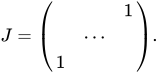
Then Jacobi's theorem states that the r th higher adjugate matrix is:

It follows immediately from Jacobi's theorem that

Taking adjugates and compounds does not commute. However, compounds of adjugates can be expressed using adjugates of compounds, and vice versa. From the identities


and the Sylvester-Franke theorem, we deduce

The same technique leads to an additional identity,

Compound and adjugate matrices appear when computing determinants of linear combinations of matrices. It is elementary to check that if A and B are n × n matrices then

It is also true that:

This has the immediate consequence

05Numerical computation
In general, the computation of compound matrices is inefficient due to its high complexity. Nonetheless, there are some efficient algorithms available for real matrices with special structure.
06Applications
Compound matrices can be used to compute the k-dimensional volume of the image of a compact set 


![\operatorname {vol} (f(R))=\int _{R}\left|C_{k}\!\left(\left[{\frac {\partial f(x)}{\partial x_{1}}}\;\cdots \;{\frac {\partial f(x)}{\partial x_{k}}}\right]\right)\right|\,dx.](https://wikimedia.org/api/rest_v1/media/math/render/svg/d4d23dc89283f56a3066a454a83a9d08b9436651)
Sources and credits
This article is adapted from the Wikipedia article “Compound matrix”, written by its contributors and licensed under CC BY-SA 4.0. Fathomly has changed the layout, removed citation markers, navigation and maintenance notices, and adjusted punctuation. This adapted version is shared under the same license. For references, see the original article.
Images, from Wikimedia Commons:
- Compound matrix and area.svg by Blacklemon67, CC BY 3.0
Fathomly is not affiliated with or endorsed by the Wikimedia Foundation. Spotted a problem? Tell us.