Software component
Modular unit of software
A software component is a modular unit of software that encapsulates specific functionality. The desired characteristics of a component are reusability and maintainability.
01Value
Components allow software developers to assemble software with reliable parts rather than writing code for every aspect. It makes implementation more like factory assembly than custom building.
02Attributes
Desirable attributes of a component include but are not limited to:
- Cohesive , encapsulates related functionality
- Substitutable , can be replaced by another component with the same interface
03Third-party
Some components are built in-house by the same organization or team building the software system. Some are third-party, developed elsewhere and assembled into the software system.
04Component-based software engineering
For large-scale systems, component-based development encourages a disciplined process to manage complexity.
05Framework
Some components conform to a framework technology that allows them to be consumed in a well-known way. Examples include: CORBA, COM, Enterprise JavaBeans, and the .NET Framework.
06Modeling
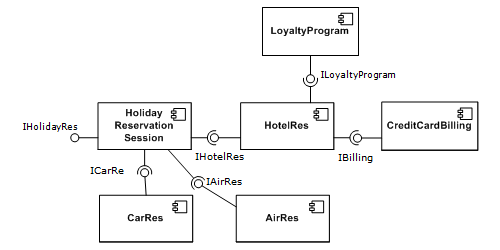
Component design is often modeled visually. In Unified Modeling Language (UML) 2.0 a component is shown as a rectangle, and an interface is shown as a lollipop to indicate a provided interface and as a socket to indicate consumption of an interface.
07History
The idea of reusable software components was promoted by Douglas McIlroy in his presentation at the NATO Software Engineering Conference of 1968. (One goal of that conference was to resolve the so-called software crisis of the time.) In the 1970s, McIlroy put this idea into practice with the addition of the pipeline feature to the Unix operating system.
Brad Cox refined the concept of a software component in the 1980s. He attempted to create an infrastructure and market for reusable third-party components by inventing the Objective-C programming language.
IBM introduced System Object Model (SOM) in the early 1990s.
Microsoft introduced Component Object Model (COM) in the early 1990s. Microsoft built many domain-specific component technologies on COM, including Distributed Component Object Model (DCOM), Object Linking and Embedding (OLE), and ActiveX.
Sources and credits
This article is adapted from the Wikipedia article “Software component”, written by its contributors and licensed under CC BY-SA 4.0. Fathomly has changed the layout, removed citation markers, navigation and maintenance notices, and adjusted punctuation. This adapted version is shared under the same license. For references, see the original article.
Images, from Wikimedia Commons:
- Component-based-Software-Engineering-example2.png by Cmendes at English Wikipedia, Public domain
Fathomly is not affiliated with or endorsed by the Wikimedia Foundation. Spotted a problem? Tell us.