Type (model theory)
Concept in model theory
In model theory and related areas of mathematics, a type is an object that describes how a (real or possible) element or finite collection of elements in a mathematical structure might behave. More precisely, it is a set of first-order formulas in a language L with free variables x1, x2,..., xn that are true of a set of n-tuples of an L-structure 
01Definitions
Consider a structure

A 1-type (of 


A complete type of 

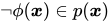

The word type in general refers to any n-type, partial or complete, over any chosen set of parameters (possibly the empty set).
An n-type p(x) is said to be realized in 

A type p(x) is said to be isolated by 

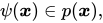


A model that realizes the maximum possible variety of types is called a saturated model, and the ultrapower construction provides one way of producing saturated models.
02Examples
Consider the language L with one binary relation symbol, which we denote as 


Consider the set of L(ω)-formulas 
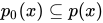


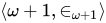

So, we wish to realize the type in an elementary extension. We can do this by defining a new L-structure, which we will denote 




Another example: the complete type of the number 2 over the empty set, considered as a member of the natural numbers, would be the set of all first-order statements (in the language of Peano arithmetic), describing a variable x, that are true when x = 2. This set would include formulas such as 



As a further example, the statements

and

describing the square root of 2 are consistent with the axioms of ordered fields, and can be extended to a complete type. This type is not realized in the ordered field of rational numbers, but is realized in the ordered field of reals. Similarly, the infinite set of formulas (over the empty set) {x>1, x>1+1, x>1+1+1, ...} is not realized in the ordered field of real numbers, but is realized in the ordered field of hyperreals. Similarly, we can specify a type 
The reason it is useful to restrict the parameters to a certain subset of the model is that it helps to distinguish the types that can be satisfied from those that cannot. For example, using the entire set of real numbers as parameters one could generate an uncountably infinite set of formulas like 

03Stone spaces
It is useful to consider the set of complete n-types over A as a topological space. Consider the following equivalence relation on formulas in the free variables x1,..., xn with parameters in A:

One can show that 
The set of formulas in free variables x1,...,xn over A up to this equivalence relation is a Boolean algebra (and is canonically isomorphic to the set of A-definable subsets of Mn). The complete n-types correspond to ultrafilters of this Boolean algebra. The set of complete n-types can be made into a topological space by taking the sets of types containing a given formula as a basis of open sets. This constructs the Stone space associated to the Boolean algebra, which is a compact, Hausdorff, and totally disconnected space.
Example. The complete theory of algebraically closed fields of characteristic 0 has quantifier elimination, which allows one to show that the possible complete 1-types (over the empty set) correspond to:
- Roots of a given irreducible non-constant polynomial over the rationals with leading coefficient 1. For example, the type of square roots of 2. Each of these types is an isolated point of the Stone space.
- Transcendental elements, which are not roots of any non-zero polynomial. This type is a point in the Stone space that is closed but not isolated.
In other words, the 1-types correspond exactly to the prime ideals of the polynomial ring Q[x] over the rationals Q: if r is an element of the model of type p, then the ideal corresponding to p is the set of polynomials with r as a root (which is only the zero polynomial if r is transcendental). More generally, the complete n-types correspond to the prime ideals of the polynomial ring Q[x1,...,xn], in other words to the points of the prime spectrum of this ring. (The Stone space topology can in fact be viewed as the Zariski topology of a Boolean ring induced in a natural way from the Boolean algebra. While the Zariski topology is not in general Hausdorff, it is in the case of Boolean rings.) For example, if q(x,y) is an irreducible polynomial in two variables, there is a 2-type whose realizations are (informally) pairs (x,y) of elements with q(x,y)=0.
04Omitting types theorem
Given a complete n-type p one can ask if there is a model of the theory that omits p, in other words there is no n-tuple in the model that realizes p. If p is an isolated point in the Stone space, i.e. if {p} is an open set, it is easy to see that every model realizes p (at least if the theory is complete). The omitting types theorem says that conversely if p is not isolated then there is a countable model omitting p (provided that the language is countable).
Example: In the theory of algebraically closed fields of characteristic 0, there is a complete 1-type represented by elements that are transcendental over the prime field Q. This is a non-isolated point of the Stone space (in fact, the only non-isolated point). The field of algebraic numbers is a model omitting this type, and the algebraic closure of any transcendental extension of the rationals is a model realizing this type.
All the other complete types are "algebraic numbers" (more precisely, they are the sets of first-order statements satisfied by some given algebraic number), and all such types are realized in all algebraically closed fields of characteristic 0.
Sources and credits
This article is adapted from the Wikipedia article “Type (model theory)”, written by its contributors and licensed under CC BY-SA 4.0. Fathomly has changed the layout, removed citation markers, navigation and maintenance notices, and adjusted punctuation. This adapted version is shared under the same license. For references, see the original article.
Fathomly is not affiliated with or endorsed by the Wikimedia Foundation. Spotted a problem? Tell us.