Reference articles on history, science, culture and more
Encyclopedia

Complete field

In mathematics, a complete field is a field equipped with a metric and complete with respect to that metric. A field supports the elementary operations of addition, subtraction, multiplication, and division, while a metric represents the distance between two points in the set. Basic examples include the real numbers, the complex numbers, and complete valued fields (such as the p-adic numbers).

01Definitions

Field

A field is a set F with binary operations + and \cdot (called addition and multiplication, respectively), along with elements 0 and 1 such that for all a,b,c\in F, the following relations hold:

  1. a+(b+c)=(a+b)+c
  2. a+b=b+a
  3. a+0=a=0+a
  4. a+x=0 has a solution
  5. a(bc)=(ab)c
  6. ab=ba
  7. a(b+c)=ab+ac and (a+b)c=ac+bc
  8. a1=a=1a
  9. ax=1 has a solution for a\neq 0

Complete metric

A metric on a set F is a function d:F^{2}\to [0,\infty ), that is, it takes two points in F and sends them to a non-negative real number, such that the following relations hold for all x,y,z\in F:

  1. d(x,y)=0 if and only if x=y
  2. d(x,y)=d(y,x)
  3. d(x,y)\leq d(x,z)+d(z,y)

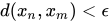
A sequence x_{n} in the space is Cauchy with respect to this metric if for all \epsilon >0 there exists an N\in \mathbb {N} such that for all n,m\geq N we have d(x_{n},x_{m})<\epsilon, and a metric is then complete if every Cauchy sequence in the metric space converges, that is, there is some x\in F where for all \epsilon >0 there exists an N\in \mathbb {N} such that for all n\geq N we have d(x_{n},x)<\epsilon. Every convergent sequence is Cauchy, however the converse does not hold in general.

02Constructions

Real and complex numbers

The real numbers are the field with the standard Euclidean metric |x-y|, and this measure is complete. Extending the reals by adding the imaginary number i satisfying i^{2}=-1 gives the field \mathbb {C}, which is also a complete field.

p-adic

The p-adic numbers are constructed from \mathbb {Q} by using the p-adic absolute value

v_{p}(a/b)=v_{p}(a)-v_{p}(b)

where a,b\in \mathbb {Z} . Then using the factorization a=p^{n}c where p does not divide c, its valuation is the integer n. The completion of \mathbb {Q} by v_{p} is the complete field \mathbb {Q} _{p} called the p-adic numbers. This is a case where the field is not algebraically closed. Typically, the process is to take the separable closure and then complete it again. This field is usually denoted \mathbb {C} _{p}.

Watch videos about Complete fieldExplainers and documentaries on YouTube (opens in a new tab)

Sources and credits

This article is adapted from the Wikipedia article Complete field, written by its contributors and licensed under CC BY-SA 4.0. Fathomly has changed the layout, removed citation markers, navigation and maintenance notices, and adjusted punctuation. This adapted version is shared under the same license. For references, see the original article.

Fathomly is not affiliated with or endorsed by the Wikimedia Foundation. Spotted a problem? Tell us.