Compact quantum group
Abstract structure in mathematics
In mathematics, compact quantum groups are generalisations of compact groups, where the commutative 
The basic motivation for this theory comes from the following analogy. The space of complex-valued functions on a compact Hausdorff topological space forms a commutative C*-algebra. On the other hand, by the Gelfand Theorem, a commutative C*-algebra is isomorphic to the C*-algebra of continuous complex-valued functions on a compact Hausdorff topological space, and the topological space is uniquely determined by the C*-algebra up to homeomorphism.
S. L. Woronowicz introduced the important concept of compact matrix quantum groups, which he initially called compact pseudogroups. Compact matrix quantum groups are abstract structures on which the "continuous functions" on the structure are given by elements of a C*-algebra. The geometry of a compact matrix quantum group is a special case of a noncommutative geometry.
01Formulation
For a compact topological group, G, there exists a C*-algebra homomorphism

where C(G) ⊗ C(G) is the minimal C*-algebra tensor product , the completion of the algebraic tensor product of C(G) and C(G) , such that

for all 


for all 
,
such that

for all 
On the other hand, a finite-dimensional representation of G can be used to generate a *-subalgebra of C(G) which is also a Hopf *-algebra. Specifically, if
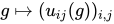
is an n-dimensional representation of G, then

for all i, j, and
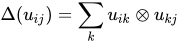
for all i, j. It follows that the *-algebra generated by 


for all 


02Compact matrix quantum groups
As a generalization, a compact matrix quantum group is defined as a pair (C, u), where C is a C*-algebra and

is a matrix with entries in C such that
- The *-subalgebra, C0, of C, which is generated by the matrix elements of u, is dense in C;
- There exists a C*-algebra homomorphism, called the comultiplication, Δ : C → C ⊗ C (here C ⊗ C is the C*-algebra tensor product - the completion of the algebraic tensor product of C and C) such that

- There exists a linear antimultiplicative map, called the coinverse, κ : C0 → C0 such that
for all
and
where I is the identity element of C. Since κ is antimultiplicative, κ(vw) = κ(w)κ(v) for all
.
As a consequence of continuity, the comultiplication on C is coassociative.
In general, C is a bialgebra, and C0 is a Hopf *-algebra.
Informally, C can be regarded as the *-algebra of continuous complex-valued functions over the compact matrix quantum group, and u can be regarded as a finite-dimensional representation of the compact matrix quantum group.
03Compact quantum groups
For C*-algebras A and B acting on the Hilbert spaces H and K respectively, their minimal tensor product is defined to be the norm completion of the algebraic tensor product A ⊗ B in B(H ⊗ K); the norm completion is also denoted by A ⊗ B.
A compact quantum group is defined as a pair (C, Δ), where C is a unital C*-algebra and
- Δ : C → C ⊗ C is a unital *-homomorphism satisfying (Δ ⊗ id) Δ = (id ⊗ Δ) Δ;
- the sets {(C ⊗ 1) Δ(C)} and {(1 ⊗ C) Δ(C)} are dense in C ⊗ C.
04Representations
A representation of the compact matrix quantum group is given by a corepresentation of the Hopf *-algebra Furthermore, a representation, v, is called unitary if the matrix for v is unitary, or equivalently, if

05Example
An example of a compact matrix quantum group is SUμ(2), where the parameter μ is a positive real number.
First definition
SUμ(2) = (C(SUμ(2)), u), where C(SUμ(2)) is the C*-algebra generated by α and γ, subject to

and
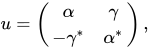
so that the comultiplication is determined by 

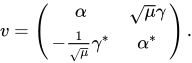
Second definition
SUμ(2) = (C(SUμ(2)), w), where C(SUμ(2)) is the C*-algebra generated by α and β, subject to

and

so that the comultiplication is determined by 



Limit case
If μ = 1, then SUμ(2) is equal to the concrete compact group SU(2).
Sources and credits
This article is adapted from the Wikipedia article “Compact quantum group”, written by its contributors and licensed under CC BY-SA 4.0. Fathomly has changed the layout, removed citation markers, navigation and maintenance notices, and adjusted punctuation. This adapted version is shared under the same license. For references, see the original article.
Fathomly is not affiliated with or endorsed by the Wikimedia Foundation. Spotted a problem? Tell us.