Common spatial pattern

Common spatial pattern (CSP) is a mathematical procedure used in signal processing for separating a multivariate signal into additive subcomponents which have maximum differences in variance between two windows.
01Details
Let 


The CSP algorithm determines the component 
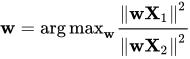
The solution is given by computing the two covariance matrices:
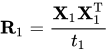
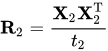
Then, the simultaneous diagonalization of those two matrices (also called generalized eigenvalue decomposition) is realized. We find the matrix of eigenvectors 

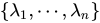
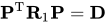
and
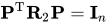
with 
This is equivalent to the eigendecomposition of 

:


02Discussion
Relation between variance ratio and eigenvalue
The eigenvectors composing
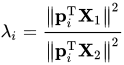
Other components
The vectorial subspace 

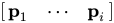

On the same way, the vectorial subspace 



Variance or second-order moment
CSP can be applied after a mean subtraction (a.k.a. "mean centering") on signals in order to realize a variance ratio optimization. Otherwise CSP optimizes the ratio of second-order moment.
Choice of windows X1 and X2
- The standard use consists on choosing the windows to correspond to two periods of time with different activation of sources (e.g. during rest and during a specific task).
- It is also possible to choose the two windows to correspond to two different frequency bands in order to find components with specific frequency pattern. Those frequency bands can be on temporal or on frequential basis. Since the matrix
- Y. Wang has proposed a particular choice for the first window
- If there is only one window,
can be considered as the identity matrix and then CSP corresponds to Principal component analysis.
Relation between LDA and CSP
Linear discriminant analysis (LDA) and CSP apply in different circumstances. LDA separates data that have different means, by finding a rotation that maximizes the (normalized) distance between the centers of the two sets of data. On the other hand, CSP ignores the means. Thus CSP is good, for example, in separating the signal from the noise in an event-related potential (ERP) experiment because both distributions have zero mean and there is no distinction for LDA to separate. Thus CSP finds a projection that makes the variance of the components of the average ERP as large as possible so the signal stands out above the noise.
03Applications
The CSP method can be applied to multivariate signals in generally, is commonly found in application to electroencephalographic (EEG) signals. Particularly, the method is often used in brain-computer interfaces to retrieve the component signals which best transduce the cerebral activity for a specific task (e.g. hand movement). It can also be used to separate artifacts from EEG signals.
CSP can be adapted for the analysis of the event-related potentials.
Sources and credits
This article is adapted from the Wikipedia article “Common spatial pattern”, written by its contributors and licensed under CC BY-SA 4.0. Fathomly has changed the layout, removed citation markers, navigation and maintenance notices, and adjusted punctuation. This adapted version is shared under the same license. For references, see the original article.
Images, from Wikimedia Commons:
- CSP Example - Pre Filter.png by MalcolmSlaney, CC BY-SA 4.0
- CSP Example - Post Filter.png by MalcolmSlaney, CC BY-SA 4.0
Fathomly is not affiliated with or endorsed by the Wikimedia Foundation. Spotted a problem? Tell us.