Common graph
Concept in extremal graph theory
In graph theory, an area of mathematics, common graphs belong to a branch of extremal graph theory concerning inequalities in homomorphism densities. Roughly speaking, 


Common graphs are closely related to other graph notions dealing with homomorphism density inequalities. For example, common graphs are a more general case of Sidorenko graphs.
01Definition
A graph

holds for any graphon 


The inequality is tight because the lower bound is always reached when 
02Interpretations of definition
For a graph 


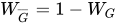

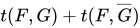

In other words, if we think of edges and non-edges as 2-coloring of edges of complete graph on the same vertices, then at least 



03Examples
- As stated above, all Sidorenko graphs are common graphs. Hence, any known Sidorenko graph is an example of a common graph, and, most notably, cycles of even length are common. However, these are limited examples since all Sidorenko graphs are bipartite graphs while there exist non-bipartite common graphs, as demonstrated below.
- The triangle graph
is one simple example of non-bipartite common graph.
, the graph obtained by removing an edge of the complete graph on 4 vertices
, is common.
- Non-example: It was believed for a time that all graphs are common. However, it turns out that
is not common for
. In particular,
04Proofs
Sidorenko graphs are common
A graph 
In that case, 



Thus, the conditions for common graph is met.
The triangle graph is common
Expand the integral expression for 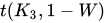
![\int _{[0,1]^{3}}(1-W(x,y))(1-W(y,z))(1-W(z,x))dxdydz=1-3\int _{[0,1]^{2}}W(x,y)+3\int _{[0,1]^{3}}W(x,y)W(x,z)dxdydz-\int _{[0,1]^{3}}W(x,y)W(y,z)W(z,x)dxdydz](https://wikimedia.org/api/rest_v1/media/math/render/svg/d38681561c55f79d8c15ced6db765d401cf52c39)
Each term in the expression can be written in terms of homomorphism densities of smaller graphs. By the definition of homomorphism densities:
![\int _{[0,1]^{2}}W(x,y)dxdy=t(K_{2},W)](https://wikimedia.org/api/rest_v1/media/math/render/svg/26a2685be2134071a0abd249e446586e831c951d)
![\int {[0,1]^{3}}W(x,y)W(x,z)dxdydz=t(K_{1,2},W)](https://wikimedia.org/api/rest_v1/media/math/render/svg/ff16f88d17a2ff6a9741c17cf143a410b39c257b)
![\int _{[0,1]^{3}}W(x,y)W(y,z)W(z,x)dxdydz=t(K_{3},W)](https://wikimedia.org/api/rest_v1/media/math/render/svg/88ebe99f4e0dfdba2dbff4b07cadac962cc98834)
where 


.


![{\begin{alignedat}{4}t(K_{1,2},W)&=\int _{[0,1]^{3}}W(x,y)W(x,z)dxdydz&&\\&=\int _{x\in [0,1]}{\bigg (}\int _{y\in [0,1]}W(x,y){\bigg )}{\bigg (}\int _{z\in [0,1]}W(x,z){\bigg )}&&\\&=\int _{x\in [0,1]}{\bigg (}\int _{y\in [0,1]}W(x,y){\bigg )}^{2}&&\\&\geq {\bigg (}\int _{x\in [0,1]}\int _{y\in [0,1]}W(x,y){\bigg )}^{2}=t(K_{2},W)^{2}\end{alignedat}}](https://wikimedia.org/api/rest_v1/media/math/render/svg/de0e4d62aa6decbd9063533cad2196b8d63a2f06)
where the last step follows from the integral Cauchy-Schwarz inequality. Finally:

This proof can be obtained from taking the continuous analog of Theorem 1 in "On Sets Of Acquaintances And Strangers At Any Party"
Sources and credits
This article is adapted from the Wikipedia article “Common graph”, written by its contributors and licensed under CC BY-SA 4.0. Fathomly has changed the layout, removed citation markers, navigation and maintenance notices, and adjusted punctuation. This adapted version is shared under the same license. For references, see the original article.
Fathomly is not affiliated with or endorsed by the Wikimedia Foundation. Spotted a problem? Tell us.