Comb space
Pathological topological space

In mathematics, particularly topology, a comb space is a particular subspace of 
01Formal definition
Consider 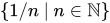
![(\{0\}\times [0,1])\cup (K\times [0,1])\cup ([0,1]\times \{0\})](https://wikimedia.org/api/rest_v1/media/math/render/svg/1840c5c3f77daef5355824188b1cc18ab96ebd57)
considered as a subspace of
.
This is the comb space with the line segment 

02Topological properties
The comb space and the deleted comb space have some interesting topological properties mostly related to the notion of connectedness.
- The comb space, C, is path connected and contractible, but not locally contractible, locally path connected, or locally connected.
- The deleted comb space, D, is connected:
- Let E be the comb space without
. E is also path connected and the closure of E is the comb space. As E
D
- Let E be the comb space without
- The deleted comb space is not path connected since there is no path from (0,1) to (0,0):
- Suppose there is a path from p = (0, 1) to the point (0, 0) in D. Let f : [0, 1] → D be this path. We shall prove that f −1{p} is both open and closed in [0, 1] contradicting the connectedness of this set. Clearly we have f −1{p} is closed in [0, 1] by the continuity of f. To prove that f −1{p} is open, we proceed as follows: Choose a neighbourhood V (open in R2) about p that doesn't intersect the x, axis. Suppose x is an arbitrary point in f −1{p}. Clearly, f(x) = p. Then since f −1(V) is open, there is a basis element U containing x such that f(U) is a subset of V. We assert that f(U) = {p} which will mean that U is an open subset of f −1{p} containing x. Since x was arbitrary, f −1{p} will then be open. We know that U is connected since it is a basis element for the order topology on [0, 1]. Therefore, f(U) is connected. Suppose f(U) contains a point s other than p. Then s = (1/n, z) must belong to D. Choose r such that 1/(n + 1) < r < 1/n. Since f(U) does not intersect the x-axis, the sets A = (−∞, r) ×
and B = (r, +∞) ×
- Suppose there is a path from p = (0, 1) to the point (0, 0) in D. Let f : [0, 1] → D be this path. We shall prove that f −1{p} is both open and closed in [0, 1] contradicting the connectedness of this set. Clearly we have f −1{p} is closed in [0, 1] by the continuity of f. To prove that f −1{p} is open, we proceed as follows: Choose a neighbourhood V (open in R2) about p that doesn't intersect the x, axis. Suppose x is an arbitrary point in f −1{p}. Clearly, f(x) = p. Then since f −1(V) is open, there is a basis element U containing x such that f(U) is a subset of V. We assert that f(U) = {p} which will mean that U is an open subset of f −1{p} containing x. Since x was arbitrary, f −1{p} will then be open. We know that U is connected since it is a basis element for the order topology on [0, 1]. Therefore, f(U) is connected. Suppose f(U) contains a point s other than p. Then s = (1/n, z) must belong to D. Choose r such that 1/(n + 1) < r < 1/n. Since f(U) does not intersect the x-axis, the sets A = (−∞, r) ×
- The comb space is homotopic to a point but does not admit a strong deformation retract onto a point for every choice of basepoint that lies in the segment
Sources and credits
This article is adapted from the Wikipedia article “Comb space”, written by its contributors and licensed under CC BY-SA 4.0. Fathomly has changed the layout, removed citation markers, navigation and maintenance notices, and adjusted punctuation. This adapted version is shared under the same license. For references, see the original article.
Images, from Wikimedia Commons:
- Comb.svg by Adam majewski, CC BY-SA 3.0
- Double comb.svg by Adam majewski, CC BY-SA 3.0
Fathomly is not affiliated with or endorsed by the Wikimedia Foundation. Spotted a problem? Tell us.


