Coleman-Weinberg potential
Potential arising from loop effects
The Coleman-Weinberg model represents quantum electrodynamics of a scalar field in four-dimensions. The Lagrangian for the model is

where the scalar field is complex, is the electromagnetic field tensor, and

the covariant derivative containing the electric charge
of the electromagnetic field.
Assume that is nonnegative. Then if the mass term is tachyonic,
there is a spontaneous breaking of the gauge symmetry at low energies, a variant of the Higgs mechanism. On the other hand, if the squared mass is positive,
the vacuum expectation of the field
is zero. At the classical level the latter is true also if
. However, as was shown by Sidney Coleman and Erick Weinberg, even if the renormalized mass is zero, spontaneous symmetry breaking still happens due to the radiative corrections (this introduces a mass scale into a classically conformal theory - the model has a conformal anomaly).
The same can happen in other gauge theories. In the broken phase the fluctuations of the scalar field will manifest themselves as a naturally light Higgs boson, as a matter of fact even too light to explain the electroweak symmetry breaking in the minimal model - much lighter than vector bosons. There are non-minimal models that give a more realistic scenarios. Also the variations of this mechanism were proposed for the hypothetical spontaneously broken symmetries including supersymmetry.
Equivalently one may say that the model possesses a first-order phase transition as a function of . The model is the four-dimensional analog of the three-dimensional Ginzburg-Landau theory used to explain the properties of superconductors near the phase transition.
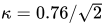
The three-dimensional version of the Coleman-Weinberg model governs the superconducting phase transition which can be both first- and second-order, depending on the ratio of the Ginzburg-Landau parameter , with a tricritical point near
which separates type I from type II superconductivity.
Historically, the order of the superconducting phase transition was debated for a long time since the temperature
interval where fluctuations are large (Ginzburg interval) is extremely small.
The question was finally settled
in 1982. If the Ginzburg-Landau parameter
that distinguishes type-I and
type-II superconductors (see also here)
is large enough, vortex fluctuations
becomes important
which drive the transition to second order.
The tricritical point lies at
roughly
, i.e., slightly below the value
where type-I goes over into type-II superconductor.
The prediction was confirmed in 2002 by Monte Carlo computer simulations.
01Literature
- S. Coleman and E. Weinberg (1973). "Radiative Corrections as the Origin of Spontaneous Symmetry Breaking". Physical Review D. 7 (6): 1888, 1910. arXiv:hep-th/0507214. Bibcode:1973PhRvD...7.1888C. doi:10.1103/PhysRevD.7.1888. S2CID 6898114.
- L.D. Landau (1937). "On the theory of phase transitions. II". Zhurnal Eksperimental'noi i Teoreticheskoi Fiziki. 7: 627.
- V.L. Ginzburg and L.D. Landau (2009). "On the Theory of Superconductivity". On Superconductivity and Superfluidity. pp. 113, 137. doi:10.1007/978-3-540-68008-6_4. ISBN 978-3-540-68004-8.
- M.Tinkham (2004). Introduction to Superconductivity. Dover Books on Physics (2nd ed.). Dover. ISBN 0-486-43503-2.
Sources and credits
This article is adapted from the Wikipedia article “Coleman-Weinberg potential”, written by its contributors and licensed under CC BY-SA 4.0. Fathomly has changed the layout, removed citation markers, navigation and maintenance notices, and adjusted punctuation. This adapted version is shared under the same license. For references, see the original article.
Fathomly is not affiliated with or endorsed by the Wikimedia Foundation. Spotted a problem? Tell us.