Coherence time
Time of electromagnetic wave coherence
For an electromagnetic wave, the coherence time is the time over which a propagating wave (especially a laser or maser beam) may be considered coherent, meaning that its phase is, on average, predictable.
In long-distance transmission systems, the coherence time may be reduced by propagation factors such as dispersion, scattering, and diffraction.
The coherence time, usually designated τ, is calculated by dividing the coherence length by the phase velocity of light in a medium; approximately given by
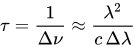
A single mode fiber laser has a linewidth of a few kHz, corresponding to a coherence time of a few hundred microseconds. Hydrogen masers have linewidth around 1 Hz, corresponding to a coherence time of about one second. Their coherence length approximately corresponds to the distance from the Earth to the Moon.
As of 2022, research groups worldwide have demonstrated superconducting qubits with coherence times up to several 100 μs.
Sources and credits
This article is adapted from the Wikipedia article “Coherence time”, written by its contributors and licensed under CC BY-SA 4.0. Fathomly has changed the layout, removed citation markers, navigation and maintenance notices, and adjusted punctuation. This adapted version is shared under the same license. For references, see the original article.
Fathomly is not affiliated with or endorsed by the Wikimedia Foundation. Spotted a problem? Tell us.