Coding gain
In coding theory, telecommunications engineering and other related engineering problems, coding gain is the measure in the difference between the signal-to-noise ratio (SNR) levels between the uncoded system and coded system required to reach the same bit error rate (BER) levels when used with the error correcting code (ECC).
01Example
If the uncoded BPSK system in AWGN environment has a bit error rate (BER) of 10−2 at the SNR level 4 dB, and the corresponding coded (e.g., BCH) system has the same BER at an SNR of 2.5 dB, then we say the coding gain = 4 dB − 2.5 dB = 1.5 dB, due to the code used (in this case BCH).
02Power-limited regime
In the power-limited regime (where the nominal spectral efficiency 


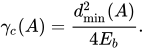
This definition is normalized so that 


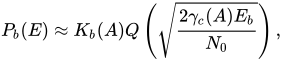
where Q is the Gaussian probability-of-error function.
For the special case of a binary linear block code 


03Example
The table below lists the nominal spectral efficiency, nominal coding gain and effective coding gain at 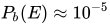

| Code |  |  | (dB) |  |  (dB) (dB)
|
|---|---|---|---|---|---|
| [8,7,2] | 1.75 | 7/4 | 2.43 | 4 | 2.0 |
| [8,4,4] | 1.0 | 2 | 3.01 | 4 | 2.6 |
| [16,15,2] | 1.88 | 15/8 | 2.73 | 8 | 2.1 |
| [16,11,4] | 1.38 | 11/4 | 4.39 | 13 | 3.7 |
| [16,5,8] | 0.63 | 5/2 | 3.98 | 6 | 3.5 |
| [32,31,2] | 1.94 | 31/16 | 2.87 | 16 | 2.1 |
| [32,26,4] | 1.63 | 13/4 | 5.12 | 48 | 4.0 |
| [32,16,8] | 1.00 | 4 | 6.02 | 39 | 4.9 |
| [32,6,16] | 0.37 | 3 | 4.77 | 10 | 4.2 |
| [64,63,2] | 1.97 | 63/32 | 2.94 | 32 | 1.9 |
| [64,57,4] | 1.78 | 57/16 | 5.52 | 183 | 4.0 |
| [64,42,8] | 1.31 | 21/4 | 7.20 | 266 | 5.6 |
| [64,22,16] | 0.69 | 11/2 | 7.40 | 118 | 6.0 |
| [64,7,32] | 0.22 | 7/2 | 5.44 | 18 | 4.6 |
04Bandwidth-limited regime
In the bandwidth-limited regime (


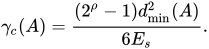
This definition is normalized so that

where 
Sources and credits
This article is adapted from the Wikipedia article “Coding gain”, written by its contributors and licensed under CC BY-SA 4.0. Fathomly has changed the layout, removed citation markers, navigation and maintenance notices, and adjusted punctuation. This adapted version is shared under the same license. For references, see the original article.
Fathomly is not affiliated with or endorsed by the Wikimedia Foundation. Spotted a problem? Tell us.
