Codensity monad
In mathematics, especially in category theory, the codensity monad is a fundamental construction associating a monad to a wide class of functors.
01Definition
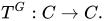
The codensity monad of a functor is defined to be the right Kan extension of
along itself, provided that this Kan extension exists. Thus, by definition it is in particular a functor
The monad structure on
stems from the universal property of the right Kan extension.
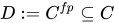
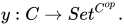
The codensity monad exists whenever is a small category (has only a set, as opposed to a proper class, of morphisms) and
possesses all (small, i.e., set-indexed) limits. It also exists whenever
has a left adjoint.
By the general formula computing right Kan extensions in terms of ends, the codensity monad is given by the following formula:
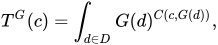
where
denotes the set of morphisms in
between the indicated objects and the integral denotes the end. The codensity monad therefore amounts to considering maps from
to an object in the image of
and maps from the set of such morphisms to
compatible for all the possible
Thus, as is noted by Avery, codensity monads share some kinship with the concept of integration and double dualization.
02Examples
Codensity monads of right adjoints
If the functor admits a left adjoint
the codensity monad is given by the composite
together with the standard unit and multiplication maps.
Concrete examples for functors not admitting a left adjoint
In several interesting cases, the functor is an inclusion of a full subcategory not admitting a left adjoint. For example, the codensity monad of the inclusion of FinSet into Set is the ultrafilter monad associating to any set
the set of ultrafilters on
This was proven by Kennison and Gildenhuys, though without using the term "codensity". In this formulation, the statement is reviewed by Leinster.
A related example is discussed by Leinster: the codensity monad of the inclusion of finite-dimensional vector spaces (over a fixed field ) into all vector spaces is the double dualization monad given by sending a vector space
to its double dual
Thus, in this example, the end formula mentioned above simplifies to considering (in the notation above) only one object namely a one-dimensional vector space, as opposed to considering all objects in
Adámek and Sousa show that, in a number of situations, the codensity monad of the inclusion
of finitely presented objects (also known as compact objects) is a double dualization monad with respect to a sufficiently nice cogenerating object. This recovers both the inclusion of finite sets in sets (where a cogenerator is the set of two elements), and also the inclusion of finite-dimensional vector spaces in vector spaces (where the cogenerator is the ground field).
Sipoş showed that the algebras over the codensity monad of the inclusion of finite sets (regarded as discrete topological spaces) into topological spaces are equivalent to Stone spaces. Avery shows that the Giry monad arises as the codensity monad of natural forgetful functors between certain categories of convex vector spaces to measurable spaces.
03Relation to Isbell duality
Di Liberti shows that the codensity monad is closely related to Isbell duality: for a given small category Isbell duality refers to the adjunction
between the category of presheaves on
(that is, functors from the opposite category of
to sets) and the opposite category of copresheaves on
The monad
induced by this adjunction is shown to be the codensity monad of the Yoneda embedding
Conversely, the codensity monad of a full small dense subcategory
in a cocomplete category
is shown to be induced by Isbell duality.
Sources and credits
This article is adapted from the Wikipedia article “Codensity monad”, written by its contributors and licensed under CC BY-SA 4.0. Fathomly has changed the layout, removed citation markers, navigation and maintenance notices, and adjusted punctuation. This adapted version is shared under the same license. For references, see the original article.
Fathomly is not affiliated with or endorsed by the Wikimedia Foundation. Spotted a problem? Tell us.