Reference articles on history, science, culture and more
Encyclopedia

Cissoid

Plane curve constructed from two other curves and a fixed point

Image credit is listed at the end of this article.

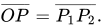
In geometry, a cissoid (/ˈsɪsɔɪd/; from Ancient Greek κισσοειδής (kissoeidēs) 'ivy-shaped') is a plane curve generated from two given curves C1, C2 and a point O (the pole). Let L be a variable line passing through O and intersecting C1 at P1 and C2 at P2. Let P be the point on L so that {\overline {OP}}={\overline {P_{1}P_{2}}}. (There are actually two such points but P is chosen so that P is in the same direction from O as P2 is from P1.) Then the locus of such points P is defined to be the cissoid of the curves C1, C2 relative to O.
Slightly different but essentially equivalent definitions are used by different authors. For example, P may be defined to be the point so that {\overline {OP}}={\overline {OP_{1}}}+{\overline {OP_{2}}}. This is equivalent to the other definition if C1 is replaced by its reflection through O. Or P may be defined as the midpoint of P1 and P2; this produces the curve generated by the previous curve scaled by a factor of 1/2.

01Equations

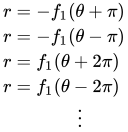
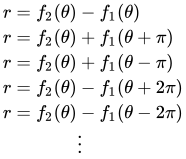
If C1 and C2 are given in polar coordinates by r=f_{1}(\theta ) and r=f_{2}(\theta ) respectively, then the equation r=f_{2}(\theta )-f_{1}(\theta ) describes the cissoid of C1 and C2 relative to the origin. However, because a point may be represented in multiple ways in polar coordinates, there may be other branches of the cissoid which have a different equation. Specifically, C1 is also given by {\begin{aligned}&r=-f_{1}(\theta +\pi )\\&r=-f_{1}(\theta -\pi )\\&r=f_{1}(\theta +2\pi )\\&r=f_{1}(\theta -2\pi )\\&\qquad \qquad \vdots \end{aligned}} So the cissoid is actually the union of the curves given by the equations {\begin{aligned}&r=f_{2}(\theta )-f_{1}(\theta )\\&r=f_{2}(\theta )+f_{1}(\theta +\pi )\\&r=f_{2}(\theta )+f_{1}(\theta -\pi )\\&r=f_{2}(\theta )-f_{1}(\theta +2\pi )\\&r=f_{2}(\theta )-f_{1}(\theta -2\pi )\\&\qquad \qquad \vdots \end{aligned}} It can be determined on an individual basis depending on the periods of f1 and f2, which of these equations can be eliminated due to duplication.

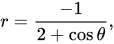
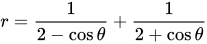
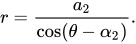
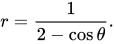
For example, let C1 and C2 both be the ellipse r={\frac {1}{2-\cos \theta }}. The first branch of the cissoid is given by r={\frac {1}{2-\cos \theta }}-{\frac {1}{2-\cos \theta }}=0, which is simply the origin. The ellipse is also given by r={\frac {-1}{2+\cos \theta }}, so a second branch of the cissoid is given by r={\frac {1}{2-\cos \theta }}+{\frac {1}{2+\cos \theta }} which is an oval shaped curve.
If each C1 and C2 are given by the parametric equations x=f_{1}(p),\ y=px and x=f_{2}(p),\ y=px, then the cissoid relative to the origin is given by x=f_{2}(p)-f_{1}(p),\ y=px.

Ellipse in red, with its two cissoid branches in black and blue (origin)

02Specific cases

When C1 is a circle with center O then the cissoid is conchoid of C2.

When C1 and C2 are parallel lines then the cissoid is a third line parallel to the given lines.

Hyperbolas

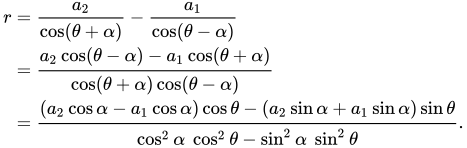
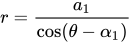
Let C1 and C2 be two non-parallel lines and let O be the origin. Let the polar equations of C1 and C2 be r={\frac {a_{1}}{\cos(\theta -\alpha _{1})}} and r={\frac {a_{2}}{\cos(\theta -\alpha _{2})}}. By rotation through angle {\tfrac {\alpha _{1}-\alpha _{2}}{2}}, we can assume that \alpha _{1}=\alpha ,\ \alpha _{2}=-\alpha . Then the cissoid of C1 and C2 relative to the origin is given by {\begin{aligned}r&={\frac {a_{2}}{\cos(\theta +\alpha )}}-{\frac {a_{1}}{\cos(\theta -\alpha )}}\\&={\frac {a_{2}\cos(\theta -\alpha )-a_{1}\cos(\theta +\alpha )}{\cos(\theta +\alpha )\cos(\theta -\alpha )}}\\&={\frac {(a_{2}\cos \alpha -a_{1}\cos \alpha )\cos \theta -(a_{2}\sin \alpha +a_{1}\sin \alpha )\sin \theta }{\cos ^{2}\alpha \ \cos ^{2}\theta -\sin ^{2}\alpha \ \sin ^{2}\theta }}.\end{aligned}} Combining constants gives r={\frac {b\cos \theta +c\sin \theta }{\cos ^{2}\theta -m^{2}\sin ^{2}\theta }} which in Cartesian coordinates is x^{2}-m^{2}y^{2}=bx+cy. This is a hyperbola passing through the origin. So the cissoid of two non-parallel lines is a hyperbola containing the pole. A similar derivation show that, conversely, any hyperbola is the cissoid of two non-parallel lines relative to any point on it.
Cissoids of Zahradnik

A cissoid of Zahradnik (named after Karel Zahradnik) is defined as the cissoid of a conic section and a line relative to any point on the conic. This is a broad family of rational cubic curves containing several well-known examples. Specifically:

  • The right strophoid y^{2}(a+x)=x^{2}(a-x) is the cissoid of the circle (x+a)^{2}+y^{2}=a^{2} and the line x=-a relative to the origin.
  • The cissoid of Diocles x(x^{2}+y^{2})+2ay^{2}=0 is the cissoid of the circle (x+a)^{2}+y^{2}=a^{2} and the line x=-2a relative to the origin. This is, in fact, the curve for which the family is named and some authors refer to this as simply as cissoid.
  • The cissoid of the circle (x+a)^{2}+y^{2}=a^{2} and the line x=ka, where k is a parameter, is called a Conchoid of de Sluze. (These curves are not actually conchoids.) This family includes the previous examples.
  • The folium of Descartes x^{3}+y^{3}=3axy is the cissoid of the ellipse x^{2}-xy+y^{2}=-a(x+y) and the line x+y=-a relative to the origin. To see this, note that the line can be written x=-{\frac {a}{1+p}},\ y=px and the ellipse can be written x=-{\frac {a(1+p)}{1-p+p^{2}}},\ y=px. So the cissoid is given by x=-{\frac {a}{1+p}}+{\frac {a(1+p)}{1-p+p^{2}}}={\frac {3ap}{1+p^{3}}},\ y=px which is a parametric form of the folium.
Animation visualizing the Cissoid of Diocles
Watch videos about CissoidExplainers and documentaries on YouTube (opens in a new tab)

Sources and credits

This article is adapted from the Wikipedia article Cissoid, written by its contributors and licensed under CC BY-SA 4.0. Fathomly has changed the layout, removed citation markers, navigation and maintenance notices, and adjusted punctuation. This adapted version is shared under the same license. For references, see the original article.

Images, from Wikimedia Commons:

Fathomly is not affiliated with or endorsed by the Wikimedia Foundation. Spotted a problem? Tell us.