Circumference
Perimeter of a circle or ellipse

In geometry, the circumference (from Latin circumferēns 'carrying around, circling') is the perimeter of a circle or ellipse. The circumference is the arc length of the circle, as if it were opened up and straightened out to a line segment. More generally, the perimeter is the curve length around any closed figure. Circumference may also refer to the circle itself, that is, the locus corresponding to the edge of a disk. The circumference of a sphere is the circumference, or length, of any one of its great circles.
01Circle
The circumference of a circle is the distance around it, but if, as in many elementary treatments, distance is defined in terms of straight lines, this cannot be used as a definition. Under these circumstances, the circumference of a circle may be defined as the limit of the perimeters of inscribed regular polygons as the number of sides increases without bound. The term circumference is used when measuring physical objects, as well as when considering abstract geometric forms.
Archimedes described how the circumference can be defined and computed using the method of exhaustion. In modern terms, one considers a set 


Relationship with π
The circumference of a circle is related to one of the most important mathematical constants. This constant, pi, is represented by the Greek letter 


Or, equivalently, as the ratio of the circumference to twice the radius. The above formula can be rearranged to solve for the circumference:

The ratio of the circle's circumference to its radius is equivalent to 
In Measurement of a Circle written circa 250 BCE, Archimedes showed that this ratio (written as 
Circumference in analysis
In modern mathematical analysis, the circumference of a circle can be defined as its one-dimensional measure. One common intrinsic definition is by Hausdorff measure. If 
For sufficiently regular curves, this measure agrees with the usual notion of arc length. Equivalently, if ![\gamma :[a,b]\to \mathbb {R} ^{2}](https://wikimedia.org/api/rest_v1/media/math/render/svg/f1d326a550ef41246054e0311de07e1375d535f3)


Applying this to the circle of radius (r), with parametrization


02Ellipse
Some authors use circumference to denote the perimeter of an ellipse. There is no general formula for the circumference of an ellipse in terms of the semi-major and semi-minor axes of the ellipse that uses only elementary functions. However, there are approximate formulas in terms of these parameters. One such approximation, due to Euler (1773), for the canonical ellipse,
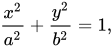





Here the upper bound 

The circumference of an ellipse can be expressed exactly in terms of the complete elliptic integral of the second kind. More precisely,


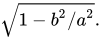

Sources and credits
This article is adapted from the Wikipedia article “Circumference”, written by its contributors and licensed under CC BY-SA 4.0. Fathomly has changed the layout, removed citation markers, navigation and maintenance notices, and adjusted punctuation. This adapted version is shared under the same license. For references, see the original article.
Images, from Wikimedia Commons:
- Pi-unrolled-720.gif by John Reid, CC BY-SA 3.0
- Circle-withsegments.svg by Jokes Free4Me, Public domain
- 2pi-unrolled.gif by Pi-unrolled: John Reid 2 pi-unrolled: Ufo karadagli, CC BY-SA 3.0
- Ellipses same circumference.png by WeiaR, CC BY-SA 4.0
Fathomly is not affiliated with or endorsed by the Wikimedia Foundation. Spotted a problem? Tell us.


