Channel surface
Surface formed from spheres centered along a curve

In geometry and topology, a channel surface or canal surface is a surface formed as the envelope of a family of spheres whose centers lie on a space curve, its directrix. If the radii of the generating spheres are constant, the canal surface is called a pipe surface. Simple examples are:
- right circular cylinder (pipe surface, directrix is a line, the axis of the cylinder)
- torus (pipe surface, directrix is a circle),
- right circular cone (canal surface, directrix is a line (the axis), radii of the spheres not constant),
- surface of revolution (canal surface, directrix is a line).
Canal surfaces play an essential role in descriptive geometry, because in case of an orthographic projection its contour curve can be drawn as the envelope of circles.
- In technical area canal surfaces can be used for blending surfaces smoothly.
01Envelope of a pencil of implicit surfaces
Given the pencil of implicit surfaces
,
two neighboring surfaces 

and
.
For the limit 

- Let
surfaces (
being at least twice continuously differentiable). The surface defined by the two equations

is the envelope of the given pencil of surfaces.

02Canal surface
Let 


is called a canal surface and 

03Parametric representation of a canal surface
The envelope condition

of the canal surface above is for any value of 

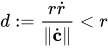


where the vectors 

For 


04Examples
- a) The first picture shows a canal surface with
- the helix
as directrix and
- the radius function
.
- The choice for
.
- the helix
- b) For the second picture the radius is constant:
, i. e. the canal surface is a pipe surface.
- c) For the 3. picture the pipe surface b) has parameter
.
- d) The 4. picture shows a pipe knot. Its directrix is a curve on a torus
- e) The 5. picture shows a Dupin cyclide (canal surface).

Sources and credits
This article is adapted from the Wikipedia article “Channel surface”, written by its contributors and licensed under CC BY-SA 4.0. Fathomly has changed the layout, removed citation markers, navigation and maintenance notices, and adjusted punctuation. This adapted version is shared under the same license. For references, see the original article.
Images, from Wikimedia Commons:
- Canal-helix-s.svg by Ag2gaeh, CC BY-SA 4.0
- Pipe-helix-spheres-s.svg by Ag2gaeh, CC BY-SA 4.0
- Pipe-helix-s.svg by Ag2gaeh, CC BY-SA 4.0
- Pipe-knot-s.svg by Ag2gaeh, CC BY-SA 4.0
- Cyclid-s.svg by Ag2gaeh, CC BY-SA 4.0
Fathomly is not affiliated with or endorsed by the Wikimedia Foundation. Spotted a problem? Tell us.
