Chan's algorithm
Algorithm for finding the convex hull of a set of points in the plane

In computational geometry, Chan's algorithm, named after Timothy M. Chan, is an optimal output-sensitive algorithm to compute the convex hull of a set 


01Algorithm
Overview
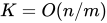
A single pass of the algorithm requires a parameter 


The algorithm starts by arbitrarily partitioning the set of points 
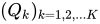
For each subset 



During the second phase, Jarvis's march is executed, making use of the precomputed (mini) convex hulls, 







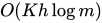
By running the two phases described above, the convex hull of
Choosing the parameter m
If an arbitrary value is chosen for 

The idea is to make multiple passes of the algorithm with increasing values of 
Squaring Strategy
One possible strategy is to square the value of 
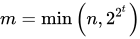


with the logarithm taken in base 

In three dimensions
To generalize this construction for the 3-dimensional case, an
Pseudocode
In the following pseudocode, text between parentheses and in italic are comments. To fully understand the following pseudocode, it is recommended that the reader is already familiar with Graham scan and Jarvis march algorithms to compute the convex hull, 
- Input: Set
- Output: Set
- (Pick a point of
- (This operation takes
time: e.g., we can simply iterate through
- (Pick a point of

- (
is used in the Jarvis march part of this Chan's algorithm,
- so that to compute the second point,
, in the convex hull of
- (Note:
- (For more info, see the comments close to the corresponding part of the Chan's algorithm.)
- (
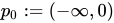
- (Note:
- (These are the iterations needed to discover the value of
- (
is required for this Chan's algorithm to find the convex hull of
- (More specifically, we want
, so that not to perform too many unnecessary iterations
- and so that the time complexity of this Chan's algorithm is
.)
- (As explained above in this article, a strategy is used where at most
iterations are required to find
- (Note: the final
.)
- (Nevertheless, this Chan's algorithm stops once
- that is, even if
, it doesn't perform
- (For more info, see the Jarvis march part of this algorithm below, where
.)
- for
do
- (Set parameter
- There are other schemes: for example, the "doubling scheme", where
, for
.
- If the "doubling scheme" is used, though, the resulting time complexity of this Chan's algorithm is
.)
- (Set parameter
- (Note:

- (Initialize an empty list (or array) to store the points of the convex hull of
- (Initialize an empty list (or array) to store the points of the convex hull of


- (Arbitrarily split set of points
subsets of roughly
- (Arbitrarily split set of points

- (Compute the convex hull of all
.)
- (It takes
time.)
- If
, then the time complexity is
.)
- for
do
- (Compute the convex hull of subset
,
time.)
- (
- (Compute the convex hull of subset
- (Compute the convex hull of all

- (At this point, the convex hulls
of respectively the subsets of points
- (Now, use a modified version of the Jarvis march algorithm to compute the convex hull of
- (Jarvis march performs in
time, where
- (Given that Jarvis march is an output-sensitive algorithm, its running time depends on the size of the convex hull,
- (In practice, it means that Jarvis march performs
- At each of these iterations, it performs at most
- (We want
- (If the current
- (In this modified version of Jarvis march, we perform an operation inside the innermost loop which takes
time.
- Hence, the total time complexity of this modified version is
- If
- for
do
- (At this point, the convex hulls

- (Note: here, a point in the convex hull of
.)
- (Note: here, a point in the convex hull of
- (In this inner for loop,
, are computed.)
- (Each of these
- that is,
is a possible next point on the convex hull of
- (Note:
: that is, for each iteration
- (Note: at each iteration
- for
- (
finds the point
such that the angle
is maximized ,
- where
and
. Such
is stored in
- (Angles do not need to be calculated directly: the orientation test can be used .)
- (
- (Note: at the iteration
,
and
- in this case, it is the point of
- (
- (In this inner for loop,

- (Choose the point
which maximizes the angle
to be the next point on the convex hull of
- (Choose the point

- (Jarvis march terminates when the next selected point on the convext hull,
- if
- (Return the convex hull of
points.)
- (Note: of course, no need to return
- return
- (Return the convex hull of
- else
- (Jarvis march terminates when the next selected point on the convext hull,

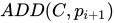
- (If after
- (We need to start over with a higher value for
- (If after
02Implementation
Chan's paper contains several suggestions that may improve the practical performance of the algorithm, for example:
- When computing the convex hulls of the subsets, eliminate the points that are not in the convex hull from consideration in subsequent executions.
- The convex hulls of larger point sets can be obtained by merging previously calculated convex hulls, instead of recomputing from scratch.
- With the above idea, the dominant cost of algorithm lies in the pre-processing, i.e., the computation of the convex hulls of the groups. To reduce this cost, we may consider reusing hulls computed from the previous iteration and merging them as the group size is increased.
03Extensions
Chan's paper contains some other problems whose known algorithms can be made optimal output sensitive using his technique, for example:
- Computing the lower envelope
of a set
of
- Hershberger gave an
- Constructing output sensitive algorithms for higher dimensional convex hulls. With the use of grouping points and using efficient data structures,
Sources and credits
This article is adapted from the Wikipedia article “Chan's algorithm”, written by its contributors and licensed under CC BY-SA 4.0. Fathomly has changed the layout, removed citation markers, navigation and maintenance notices, and adjusted punctuation. This adapted version is shared under the same license. For references, see the original article.
Images, from Wikimedia Commons:
- ChanAlgDemo.gif by Shiyu Ji, CC BY-SA 4.0
Fathomly is not affiliated with or endorsed by the Wikimedia Foundation. Spotted a problem? Tell us.