Cartesian monoid
A Cartesian monoid is a monoid, with additional structure of pairing and projection operators. It was first formulated by Dana Scott and Joachim Lambek independently.
01Definition
A Cartesian monoid is a structure with signature 


- Monoid
- Left Projection
- Right Projection
- Surjective Pairing
- Right Homogeneity
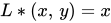
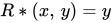


The interpretation is that 

Sources and credits
This article is adapted from the Wikipedia article “Cartesian monoid”, written by its contributors and licensed under CC BY-SA 4.0. Fathomly has changed the layout, removed citation markers, navigation and maintenance notices, and adjusted punctuation. This adapted version is shared under the same license. For references, see the original article.
Fathomly is not affiliated with or endorsed by the Wikimedia Foundation. Spotted a problem? Tell us.