Regular grid
Tessellation of Euclidean space

A regular grid is a tessellation of n-dimensional Euclidean space by congruent parallelotopes (e.g. bricks). Its opposite is irregular grid.
Grids of this type appear on graph paper and may be used in finite element analysis, finite volume methods, finite difference methods, and in general for discretization of parameter spaces. Since the derivatives of field variables can be conveniently expressed as finite differences, structured grids mainly appear in finite difference methods. Unstructured grids offer more flexibility than structured grids and hence are very useful in finite element and finite volume methods.
Each cell in the grid can be addressed by index (i, j) in two dimensions or (i, j, k) in three dimensions, and each vertex has coordinates 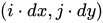

Sources and credits
This article is adapted from the Wikipedia article “Regular grid”, written by its contributors and licensed under CC BY-SA 4.0. Fathomly has changed the layout, removed citation markers, navigation and maintenance notices, and adjusted punctuation. This adapted version is shared under the same license. For references, see the original article.
Images, from Wikimedia Commons:
- Regular grid.svg by Slffea, Mysid, CC BY-SA 3.0
Fathomly is not affiliated with or endorsed by the Wikimedia Foundation. Spotted a problem? Tell us.


