Jurin's law
Analysis of capillary action

Jurin's law, or capillary rise, is the simplest analysis of capillary action, the induced motion of liquids in small channels, and states that the maximum height of a liquid in a capillary tube is inversely proportional to the tube's diameter. Capillary action is one of the most common fluid mechanical effects explored in the field of microfluidics. Jurin's law is named after James Jurin, who discovered it between 1718 and 1719. The difference in height between the surroundings of the tube and the inside, as well as the shape of the meniscus, mathematical expression of this law can be derived directly from hydrostatic principles and the Young-Laplace equation. Jurin's law allows the measurement of the surface tension of a liquid and can be used to derive the capillary length.
01Formulation
The law is expressed as
,
where
- h is the liquid height;
is the surface tension;
- θ is the contact angle of the liquid on the tube wall;
- ρ is the mass density (mass per unit volume);
- r0 is the tube radius;
- g is the gravitational acceleration.
It is only valid if the tube is cylindrical and has a radius (r0) smaller than the capillary length (
.

02Examples
For a water-filled glass tube in air at standard conditions for temperature and pressure, γ = 0.0728 N/m at 20 °C, ρ = 1000 kg/m3, and g = 9.81 m/s2. Because water spreads on clean glass, the effective equilibrium contact angle is approximately zero. For these values, the height of the water column is
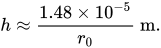
Thus for a 2 m (6.6 ft) radius glass tube in lab conditions given above, the water would rise an unnoticeable 0.007 mm (0.00028 in). However, for a 2 cm (0.79 in) radius tube, the water would rise 0.7 mm (0.028 in), and for a 0.2 mm (0.0079 in) radius tube, the water would rise 70 mm (2.8 in).
Capillary action is used by many plants to bring up water from the soil. For tall trees (larger than about 10 m or 33 ft), other processes like osmotic pressure and negative pressures are also important.
03History
During the 15th century, Leonardo da Vinci was one of the first to propose that mountain streams could result from the rise of water through small capillary cracks.
It is later, in the 17th century, that the theories about the origin of capillary action begin to appear. Jacques Rohault erroneously supposed that the rise of the liquid in a capillary could be due to the suppression of air inside and the creation of a vacuum. The astronomer Geminiano Montanari was one of the first to compare the capillary action to the circulation of sap in plants. Additionally, the experiments of Giovanni Alfonso Borelli determined in 1670 that the height of the rise was inversely proportional to the radius of the tube.
Francis Hauksbee, in 1713, refuted the theory of Rohault through a series of experiments on capillary action, a phenomenon that was observable in air as well as in vacuum. Hauksbee also demonstrated that the liquid rise appeared on different geometries (not only circular cross sections), and on different liquids and tube materials, and showed that there was no dependence on the thickness of the tube walls. Isaac Newton reported the experiments of Hauskbee in his work Opticks but without attribution.
It was the English physiologist James Jurin, who finally in 1718 confirmed the experiments of Borelli and the law was named in his honour.

04Derivation
The height 
Hydrostatic pressure
A static fluid experiences a simple vertical pressure variation with height: 


For much the same reasons, the same equation describes pressure variation in the air above, but with 


Laplace pressure
In fact, 
By the Young-Laplace equation, 

The meniscus cross-section is circular, with radius 


Result at equilibrium
The hydrostatic analysis shows that 

Sources and credits
This article is adapted from the Wikipedia article “Jurin's law”, written by its contributors and licensed under CC BY-SA 4.0. Fathomly has changed the layout, removed citation markers, navigation and maintenance notices, and adjusted punctuation. This adapted version is shared under the same license. For references, see the original article.
Images, from Wikimedia Commons:
- Capillarity.svg by MesserWoland, CC BY-SA 3.0
- 2014.06.17 Water height capillary.jpg by Hermann Luyken, CC0
- Jurin equation.png by FlankerFF at Russian Wikipedia, Public domain
Fathomly is not affiliated with or endorsed by the Wikimedia Foundation. Spotted a problem? Tell us.