Compound annual growth rate
Geometric progression ratio that provides a constant rate of return over the time period
| Value | Year | |
|---|---|---|
| Initial value | $100 | 1990 |
| Final value | $800 | 2005 |
| CAGR of 14.9% over 15 years | ||
Compound annual growth rate (CAGR) is a business, economics and investing term representing the mean annualized growth rate for compounding values over a given time period. CAGR smooths the effect of volatility of periodic values that can render arithmetic means less meaningful. It is particularly useful to compare growth rates of various data values, such as revenue growth of companies, or of economic values, over time.
01Equation
For annual values, CAGR is defined as:
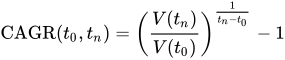
where 


CAGR can also be used to calculate mean annualized growth rates on quarterly or monthly values. The numerator of the exponent would be the value of 4 in the case of quarterly, and 12 in the case of monthly, with the denominator being the number of corresponding periods involved.
In practice, CAGR calculations are often performed in Microsoft Excel. A convenient built-in function is 


CAGR is a good method to compare returns of 2 investment instruments (Bonds/stocks/Gsecs etc) over a multi-year period.
02Applications
These are some of the common CAGR applications:
- Calculating and communicating the mean returns of investment funds
- Demonstrating and comparing the performance of investment advisors
- Comparing the historical returns of stocks with bonds or with a savings account
- Forecasting future values based on the CAGR of a data series (you find future values by multiplying the last datum of the series by (1 + CAGR) as many times as years required). As with every forecasting method, this method has a calculation error associated.
- Analyzing and communicating the behavior, over a series of years, of different business measures such as sales, market share, costs, customer satisfaction, and performance.
- Calculating mean annualized growth rates of economic data, such as gross domestic product, over annual, quarterly or monthly time intervals.
Sources and credits
This article is adapted from the Wikipedia article “Compound annual growth rate”, written by its contributors and licensed under CC BY-SA 4.0. Fathomly has changed the layout, removed citation markers, navigation and maintenance notices, and adjusted punctuation. This adapted version is shared under the same license. For references, see the original article.
Fathomly is not affiliated with or endorsed by the Wikimedia Foundation. Spotted a problem? Tell us.