Bulk modulus
Resistance of a material to uniform pressure

The bulk modulus (


Other moduli describe the material's response (strain) to other kinds of stress: the shear modulus describes the response to shear stress and Young's modulus describes the response to normal (lengthwise stretching) stress. For a fluid, only the bulk modulus is meaningful. For a complex anisotropic solid such as wood or paper, these three moduli do not contain enough information to describe its behaviour, and one must use the full generalized Hooke's law. The reciprocal of the bulk modulus at fixed temperature is called the isothermal compressibility.
01Definition
The bulk modulus
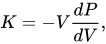
where 


where 


02Thermodynamic relation
Strictly speaking, the bulk modulus is a thermodynamic quantity, and in order to specify a bulk modulus it is necessary to specify how the pressure varies during compression: constant-temperature (isothermal 

For an ideal gas, an isentropic process has:

where 

Similarly, an isothermal process of an ideal gas has:

Therefore, the isothermal bulk modulus
.
When the gas is not ideal, these equations give only an approximation of the bulk modulus. In a fluid, the bulk modulus 

In solids,
03Measurement
It is possible to measure the bulk modulus using powder diffraction under applied pressure or at elevated temperatures, as well as by other methods for fluids, elastomers, minerals such as olivines, using theoretical calculations, of even granular materials such as sand grains.

04Selected values
| Material | Bulk modulus in GPa | Bulk modulus in Mpsi |
|---|---|---|
| Diamond (at 4K) | 443 | 64 |
| Alumina (γ phase) | 162 ± 14 | 23.5 |
| Steel | 160 | 23.2 |
| Limestone | 65 | 9.4 |
| Granite | 50 | 7.3 |
| Glass (see also diagram below table) | 35 to 55 | 5.8 |
| Graphite 2H (single crystal) | 34 | 4.9 |
| Sodium chloride | 24.42 | 3.542 |
| Shale | 10 | 1.5 |
| Chalk | 9 | 1.3 |
| Rubber | 1.5 to 2 | 0.22 to 0.29 |
| Sandstone | 0.7 | 0.1 |
A material with a bulk modulus of 35 GPa loses one percent of its volume when subjected to an external pressure of 0.35 GPa (~3500 bar) (assumed constant or weakly pressure dependent bulk modulus).
| β-Carbon nitride | 427±15 GPa (predicted) |
| Plutonium | 72.9 GPa at 0 K, to 54.4 GPa at 300 K, Under high pressures (>40 GPa) it undergoes a structural phase transition, and it's bulk modulus drops to 43 GPa |
| Water | 2.2 GPa (0.32 Mpsi) (value increases at higher pressures) |
| Methanol | 823 MPa (at 20 °C and 1 Atm) |
| Solid helium | 50 MPa (approximate) |
| Air | 142 kPa (adiabatic bulk modulus [or isentropic bulk modulus]) |
| Air | 101 kPa (isothermal bulk modulus) |
05Microscopic origin
Interatomic potential and linear elasticity
Since linear elasticity is a direct result of interatomic interaction, it is related to the extension/compression of bonds. It can then be derived from the interatomic potential for crystalline materials. First, let us examine the potential energy of two interacting atoms. Starting from very far points, they will feel an attraction towards each other. As they approach each other, their potential energy will decrease. On the other hand, when two atoms are very close to each other, their total energy will be very high due to repulsive interaction. Together, these potentials guarantee an interatomic distance that achieves a minimal energy state. This occurs at some distance r0, where the total force is zero:
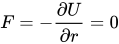
Where U is interatomic potential and r is the interatomic distance. This means the atoms are in equilibrium.
To extend the two atoms approach into solid, consider a simple model, say, a 1-D array of one element with interatomic distance of r, and the equilibrium distance is r0. Its potential energy-interatomic distance relationship has similar form as the two atoms case, which reaches minimal at r0, The Taylor expansion for this is:

At equilibrium, the first derivative is 0, so the dominant term is the quadratic one. When displacement is small, the higher order terms should be omitted. The expression becomes:


Which is clearly linear elasticity.
Note that the derivation is done considering two neighboring atoms, so the Hook's coefficient is:

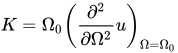
This form can be easily extended to 3-D case, with volume per atom(Ω) in place of interatomic distance.
Sources and credits
This article is adapted from the Wikipedia article “Bulk modulus”, written by its contributors and licensed under CC BY-SA 4.0. Fathomly has changed the layout, removed citation markers, navigation and maintenance notices, and adjusted punctuation. This adapted version is shared under the same license. For references, see the original article.
Images, from Wikimedia Commons:
- Isostatic pressure deformation.svg by AG Caesar, CC0
- SpiderGraph BulkModulus.gif by Afluegel at English Wikipedia, Public domain
- Interatomic potentual.png by Jcli1123, CC BY-SA 4.0
Fathomly is not affiliated with or endorsed by the Wikimedia Foundation. Spotted a problem? Tell us.