Brocard's problem
In mathematics, when is n!+1 a square
 have integer solutions other than
  ?
More unsolved problems in mathematics
?
More unsolved problems in mathematics
Brocard's problem is a problem in mathematics that seeks integer values of 


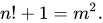
More formally, it seeks pairs of integers 
01Brown numbers
Pairs of the numbers 
based on the equalities
4! + 1 = 52 = 25, 5! + 1 = 112 = 121, and 7! + 1 = 712 = 5041.Paul Erdős conjectured that no other solutions exist. Computational searches have found no further solutions with 
02Connection to the abc conjecture
It would follow from the abc conjecture that there are only finitely many Brown numbers.
More generally, it would also follow from the abc conjecture that


Sources and credits
This article is adapted from the Wikipedia article “Brocard's problem”, written by its contributors and licensed under CC BY-SA 4.0. Fathomly has changed the layout, removed citation markers, navigation and maintenance notices, and adjusted punctuation. This adapted version is shared under the same license. For references, see the original article.
Fathomly is not affiliated with or endorsed by the Wikimedia Foundation. Spotted a problem? Tell us.