Boustrophedon transform
Mathematical transformation on sequences
In mathematics, the boustrophedon transform is a procedure which maps one sequence to another. The transformed sequence is computed by an "addition" operation, implemented as if filling a triangular array in a boustrophedon (zigzag- or serpentine-like) manner, as opposed to a "raster scan" sawtooth-like manner.
01Definition
The boustrophedon transform is a numerical, sequence-generating transformation, which is determined by a binary operation such as addition.
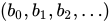
Generally speaking, given a sequence: 


Boustrophedon Triangle
To fill-out the numerical Isosceles triangle (Figure 1), you start with the input sequence,
The top vertex of the triangle will be the input value
The subsequent rows (going down to the base of the triangle) are numbered consecutively (from 0) as integers, let 
- For all rows, numbered
, there will be exactly
values in the row.
- If
on the right-hand end of the row.
- Fill-out the interior of this row from right-to-left, where each value (index:
) is the result of "addition" between the value to right (index:
) and the value to the upper right (index:
).
- The output value
will be on the left-hand end of an odd row (where
- Fill-out the interior of this row from right-to-left, where each value (index:
- If
- Fill-out the interior of this row from left-to-right, where each value (index:
) and the value to its upper left (index:
).
- The output value
- Fill-out the interior of this row from left-to-right, where each value (index:
Refer to the arrows in Figure 1 for a visual representation of these "addition" operations.
For a given, finite input-sequence: 


02Recurrence relation
A more formal definition uses a recurrence relation. Define the numbers 
.




Then the transformed sequence is defined by 

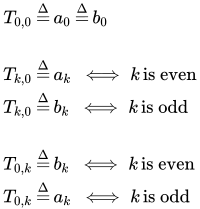
Per this definition, note the following definitions for values outside the restrictions (from the relationship above) on 
Special Cases
In the case a0 = 1, an = 0 (n > 0), the resulting triangle is called the Seidel, Entringer, Arnold Triangle and the numbers
In this case the numbers in the transformed sequence bn are called the Euler up/down numbers. This is sequence A000111 on the On-Line Encyclopedia of Integer Sequences. These enumerate the number of alternating permutations on n letters and are related to the Euler numbers and the Bernoulli numbers.
03Algebraic definition(s)
Building from the geometric design of the boustrophedon transform, algebraic definitions of the relationship from input values (

Euclidean (Real) values
In the Euclidean (

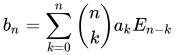
with the reverse relationship (input from output) defined as:
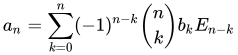
where (En) is the sequence of "up/down" numbers, also known as secant or tangent numbers.
04The exponential generating function
The exponential generating function of a sequence (an) is defined by
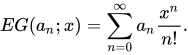
The exponential generating function of the boustrophedon transform (bn) is related to that of the original sequence (an) by

The exponential generating function of the unit sequence is 1, so that of the up/down numbers is sec x + tan x.
Sources and credits
This article is adapted from the Wikipedia article “Boustrophedon transform”, written by its contributors and licensed under CC BY-SA 4.0. Fathomly has changed the layout, removed citation markers, navigation and maintenance notices, and adjusted punctuation. This adapted version is shared under the same license. For references, see the original article.
Images, from Wikimedia Commons:
- Boustrophedon transform.svg by No machine-readable author provided. Jitse Niesen assumed (based on copyright claims)., Public domain
Fathomly is not affiliated with or endorsed by the Wikimedia Foundation. Spotted a problem? Tell us.