Bjerrum length
Comparative measure of electrostatic and thermal energy

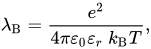
The Bjerrum length (after Danish chemist Niels Bjerrum 1879-1958 ) is the separation at which the electrostatic interaction between two elementary charges is comparable in magnitude to the thermal energy scale, 


In standard units, the Bjerrum length is given by



In Gaussian units, 
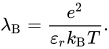
The relative permittivity εr of water decreases so strongly with temperature that the product (εr·T) decreases. Therefore, in spite of the (1/T) relation, the Bjerrum length λB increases with temperature, as shown in the graph above.
Sources and credits
This article is adapted from the Wikipedia article “Bjerrum length”, written by its contributors and licensed under CC BY-SA 4.0. Fathomly has changed the layout, removed citation markers, navigation and maintenance notices, and adjusted punctuation. This adapted version is shared under the same license. For references, see the original article.
Images, from Wikimedia Commons:
- Bjerrum length in water in nanometers.png by PChemiker, CC BY-SA 4.0
Fathomly is not affiliated with or endorsed by the Wikimedia Foundation. Spotted a problem? Tell us.