Birth process
Type of continuous process in probability theory

In probability theory, a birth process or a pure birth process is a special case of a continuous-time Markov process and a generalisation of a Poisson process. It defines a continuous process which takes values in the natural numbers and can only increase by one (a "birth") or remain unchanged. This is a type of birth-death process with no deaths. The rate at which births occur is given by an exponential random variable whose parameter depends only on the current value of the process
01Definition
Birth rates definition
A birth process with birth rates 




Infinitesimal definition
A birth process with rates
is independent of




(The third and fourth conditions use little o notation.)
These conditions ensure that the process starts at 


Continuous-time Markov chain definition
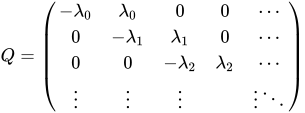
A birth process can be defined as a continuous-time Markov process (CTMC) 
Variations
Some authors require that a birth process start from 0 i.e. that 

02Properties
As for CTMCs, a birth process has the Markov property. The CTMC definitions for communicating classes, irreducibility and so on apply to birth processes. By the conditions for recurrence and transience of a birth-death process, any birth process is transient. The transition matrices 
The backwards equations are:
(for
)
The forward equations are:
(for
)
(for
)
From the forward equations it follows that:
(for
(for
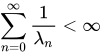
Unlike a Poisson process, a birth process may have infinitely many births in a finite amount of time. We define 


03Examples
A Poisson process is a birth process where the birth rates are constant i.e. 

Simple birth process
A simple birth process is a birth process with rates 

The number of births in time 

In exact form, the number of births is the negative binomial distribution with parameters 

The expectation of the process grows exponentially; specifically, if 

A simple birth process with immigration is a modification of this process with rates 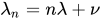
Sources and credits
This article is adapted from the Wikipedia article “Birth process”, written by its contributors and licensed under CC BY-SA 4.0. Fathomly has changed the layout, removed citation markers, navigation and maintenance notices, and adjusted punctuation. This adapted version is shared under the same license. For references, see the original article.
Images, from Wikimedia Commons:
- Birth process.svg by Bilorv, CC0
- Poisson process.svg by Bilorv, CC0
- Simple birth process.svg by Bilorv, CC0
Fathomly is not affiliated with or endorsed by the Wikimedia Foundation. Spotted a problem? Tell us.