Binary GCD algorithm
Algorithm for computing the greatest common divisor

The binary GCD algorithm, also known as Stein's algorithm or the binary Euclidean algorithm, is an algorithm that computes the greatest common divisor (GCD) of two nonnegative integers. Stein's algorithm uses simpler arithmetic operations than the conventional Euclidean algorithm; it replaces division with arithmetic shifts, comparisons, and subtraction.
Although the algorithm in its contemporary form was first published by the physicist and programmer Josef Stein in 1967, it was known by the 2nd century BCE, in ancient China.
01Algorithm
The algorithm finds the GCD of two nonnegative numbers 

: everything divides zero, and
:
is a common divisor.
if
if
odd and
.
As GCD is commutative (


02Implementation
While the above description of the algorithm is mathematically correct, the binary GCD algorithm performs more loop iterations that the Euclidean one, so it only offers a performance advantage if those iterations are substantially faster. Performant software implementations typically differ from it in a few notable ways:
- eschewing repeated trial division by
- expressing the algorithm iteratively rather than recursively: the resulting implementation can be laid out to avoid repeated work, invoking identity 2 at the start and maintaining as invariant that both numbers are odd upon entering the loop, which only needs to implement identities 3 and 4; and
- making the loop's body branch-free except for its exit condition v == 0: unpredictable branches can have a large, negative impact on performance.
The following is an implementation of the algorithm in C.
// Count trailing zeros. This is a pedagogical example only; // for efficiency use __builtin_ctzll() or similar. static int ctz(uint64_t n) { int s = 0, t; while ((t = n & 15) == 0) { n >>= 4; s += 4; } return s + ((0x12131210 >> 2*t) & 3); } uint64_t gcd(uint64_t u, uint64_t v) { if (!u || !v) return u | v; // Identity #1 int shift = ctz(u | v); u >>= ctz(u); uint64_t min, max; while (v) { v >>= ctz(v); // Identity #3 min = (u < v) ? u : v; // Identity #4 max = (u > v) ? u : v; u = min; v = max - min; } return u << shift; // Identity #2 }
The following is an implementation of the algorithm in Rust exemplifying those differences, adapted from uutils. The conditional exchange of
Note: The implementation above accepts unsigned (non-negative) integers; given that 
03Complexity
Asymptotically, the algorithm requires 


For arbitrarily large numbers, the asymptotic complexity of this algorithm is 

This is the same as for the Euclidean algorithm, though a more precise analysis by Akhavi and Vallée proved that binary GCD uses about 60% fewer bit operations.
04Extensions
The binary GCD algorithm can be extended in several ways, either to output additional information, deal with arbitrarily large integers more efficiently, or to compute GCDs in domains other than the integers.
The extended binary GCD algorithm, analogous to the extended Euclidean algorithm, fits in the first kind of extension, as it provides the Bézout coefficients in addition to the GCD: integers 


In the case of large integers, the best asymptotic complexity is 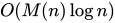

The binary GCD algorithm has also been extended to domains other than natural numbers, such as Gaussian integers, Eisenstein integers, quadratic rings, and integer rings of number fields.
05Historical description
An algorithm for computing the GCD of two numbers was known in ancient China, under the Han dynasty, as a method to reduce fractions:
If possible halve it; otherwise, take the denominator and the numerator, subtract the lesser from the greater, and do that alternately to make them the same. Reduce by the same number.
, Fangtian, Land surveying, The Nine Chapters on the Mathematical Art
The phrase "if possible halve it" is ambiguous,
- if this applies when either of the numbers become even, the algorithm is the binary GCD algorithm;
- if this only applies when both numbers are even, the algorithm is similar to the Euclidean algorithm.
Sources and credits
This article is adapted from the Wikipedia article “Binary GCD algorithm”, written by its contributors and licensed under CC BY-SA 4.0. Fathomly has changed the layout, removed citation markers, navigation and maintenance notices, and adjusted punctuation. This adapted version is shared under the same license. For references, see the original article.
Images, from Wikimedia Commons:
Fathomly is not affiliated with or endorsed by the Wikimedia Foundation. Spotted a problem? Tell us.

