Biholomorphism
Bijective holomorphic function with a holomorphic inverse

In the mathematical theory of functions of one or more complex variables, and also in complex algebraic geometry, a biholomorphism or biholomorphic function is a bijective holomorphic function whose inverse is also holomorphic. Note that the last condition is redundant: the inverse of a bijective holomorphic function is always holomorphic.
01Formal definition
Formally, a biholomorphic function is a function 


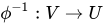
If there exists a biholomorphism 
02Riemann mapping theorem and generalizations
If 

03Alternative definitions
In the case of maps f : U → C defined on an open subset U of the complex plane C, some authors define a conformal map to be an injective map with nonzero derivative i.e., f’(z)≠ 0 for every z in U. According to this definition, a map f : U → C is conformal if and only if f: U → f(U) is biholomorphic. Notice that per definition of biholomorphisms, nothing is assumed about their derivatives, so, this equivalence contains the claim that a homeomorphism that is complex differentiable must actually have nonzero derivative everywhere. Other authors define a conformal map as one with nonzero derivative, but without requiring that the map be injective. According to this weaker definition, a conformal map need not be biholomorphic, even though it is locally biholomorphic, for example, by the inverse function theorem. For example, if f: U → U is defined by f(z) = z2 with U = C, {0}, then f is conformal on U, since its derivative f’(z) = 2z ≠ 0, but it is not biholomorphic, since it is 2-1.
Sources and credits
This article is adapted from the Wikipedia article “Biholomorphism”, written by its contributors and licensed under CC BY-SA 4.0. Fathomly has changed the layout, removed citation markers, navigation and maintenance notices, and adjusted punctuation. This adapted version is shared under the same license. For references, see the original article.
Images, from Wikimedia Commons:
- Biholomorphism illustration.svg by Oleg Alexandrov, Public domain
Fathomly is not affiliated with or endorsed by the Wikimedia Foundation. Spotted a problem? Tell us.