Beta function (physics)
Function that encodes the dependence of a coupling parameter on the energy scale

In theoretical physics, specifically quantum field theory, a beta function or Gell-Mann-Low function, β(g), encodes the dependence of a coupling parameter, g, on the energy scale, μ, of a given physical process described by quantum field theory. It is defined by the Gell-Mann-Low equation or renormalization group equation, given by

and, because of the underlying renormalization group, it has no explicit dependence on μ, so it only depends on μ implicitly through g. This dependence on the energy scale thus specified is known as the running of the coupling parameter, a fundamental feature of scale-dependence in quantum field theory, and its explicit computation is achievable through a variety of mathematical techniques. The concept of beta function was first introduced by Ernst Stueckelberg and André Petermann in 1953, and independently postulated by Murray Gell-Mann and Francis E. Low in 1954.
01History
Murray Gell-Mann and Francis E. Low restricted the idea to scale transformations in QED in 1954 and focused on asymptotic forms of the photon propagator at high energies. They determined the variation of the electromagnetic coupling in QED by considering the scaling structure, and discovered that the coupling parameter g(μ) at the energy scale μ is effectively given by the group equation

Gell-Mann and Low realized that the effective scale can be arbitrarily taken as μ, and can vary to define the theory at any other scale:

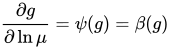
On the basis of this finite group equation and its scaling property, Gell-Mann and Low focused on infinitesimal transformations, and invented a computational method based on the function ψ(g) = G d/(∂G/∂g) which they introduced. Like the earlier function h(e), their function determines the change of the coupling g(μ) with respect to change in energy scale μ through a differential equation, the renormalization group equation
02Scale invariance
If the beta functions of a quantum field theory (QFT) vanish, usually at particular values of the coupling parameters, then the theory is said to be scale-invariant. Almost all scale-invariant QFTs are also conformally invariant. The study of such theories is conformal field theory.
The coupling parameters of a quantum field theory can run even if the corresponding classical field theory is scale-invariant. In this case, the non-zero beta function tells us that the classical scale invariance is anomalous.
03Examples
Beta functions are usually computed in some kind of approximation scheme. An example is perturbation theory, where one assumes that the coupling parameters are small. One can then make an expansion in powers of the coupling parameters and truncate the higher-order terms (also known as higher loop contributions, due to the number of loops in the corresponding Feynman graphs).
Here are some examples of beta functions computed in perturbation theory:
Quantum electrodynamics
The one-loop beta function in quantum electrodynamics (QED) is

or, equivalently,
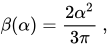
written in terms of the fine structure constant in natural units, α = e2/4π.
This beta function tells us that the coupling increases with increasing energy scale, and QED becomes strongly coupled at high energy. In fact, the coupling apparently becomes infinite at some finite energy, resulting in a Landau pole. However, one cannot expect the perturbative beta function to give accurate results at strong coupling, and so it is likely that the Landau pole is an artifact of applying perturbation theory in a situation where it is no longer valid.
Quantum chromodynamics
The one-loop beta function in quantum chromodynamics with 


or

written in terms of αs = 
Assuming ns=0, if nf ≤ 16, the ensuing beta function dictates that the coupling decreases with increasing energy scale, a phenomenon known as asymptotic freedom. Conversely, the coupling increases with decreasing energy scale. This means that the coupling becomes large at low energies, and one can no longer rely on perturbation theory.
SU(N) Non-Abelian gauge theory
While the (Yang-Mills) gauge group of QCD is 



where 




This famous result was derived nearly simultaneously in 1973 by Hugh David Politzer, David Gross and Frank Wilczek, for which the three were awarded the Nobel Prize in Physics in 2004. Unbeknownst to these authors, Gerard 't Hooft had announced the result in a comment following a talk by Kurt Symanzik at a small meeting in Marseille in June 1972, but he never published it.
Standard Model Higgs-Yukawa couplings
In the Standard Model, quarks and leptons have Yukawa couplings to the Higgs boson. These determine the mass of the particle. Most all of the quarks' and leptons' Yukawa couplings are small compared to the top quark's Yukawa coupling. These Yukawa couplings change their values depending on the energy scale at which they are measured, through running. The dynamics of Yukawa couplings of quarks are determined by the renormalization group equation:
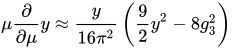
where 


The Yukawa couplings of the up, down, charm, strange and bottom quarks, are small at the extremely high energy scale of grand unification, 


On the other hand, solutions to this equation for large initial values
Minimal supersymmetric Standard Model
Renomalization group studies in the minimal supersymmetric Standard Model (MSSM) of grand unification and the Higgs-Yukawa fixed points were very encouraging that the theory was on the right track. So far, however, no evidence of the predicted MSSM particles has emerged in experiment at the Large Hadron Collider.
Sources and credits
This article is adapted from the Wikipedia article “Beta function (physics)”, written by its contributors and licensed under CC BY-SA 4.0. Fathomly has changed the layout, removed citation markers, navigation and maintenance notices, and adjusted punctuation. This adapted version is shared under the same license. For references, see the original article.
Images, from Wikimedia Commons:
- Feynman Diagram Gluon Radiation.svg by Joel Holdsworth (Joelholdsworth), Public domain
Fathomly is not affiliated with or endorsed by the Wikimedia Foundation. Spotted a problem? Tell us.
