Bernstein's problem
Problem in differential geometry
In differential geometry, Bernstein's problem is as follows: if the graph of a function on Rn−1 is a minimal surface in Rn, does this imply that the function is linear? This is true for n at most 8, but false for n at least 9. The problem is named for Sergei Natanovich Bernstein who solved the case n = 3 in 1914.
01Statement
Suppose that f is a function of n − 1 real variables. The graph of f is a surface in Rn, and the condition that this is a minimal surface is that f satisfies the minimal surface equation
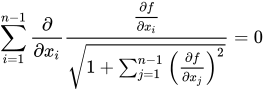
Bernstein's problem asks whether an entire function (a function defined throughout Rn−1 ) that solves this equation is necessarily a degree-1 polynomial.
02History
Bernstein (1915-1917) proved Bernstein's theorem that a graph of a real function on R2 that is also a minimal surface in R3 must be a plane.
Fleming (1962) gave a new proof of Bernstein's theorem by deducing it from the fact that there is no non-planar area-minimizing cone in R3.
De Giorgi (1965) showed that if there is no non-planar area-minimizing cone in Rn−1 then the analogue of Bernstein's theorem is true for graphs in Rn, which in particular implies that it is true in R4.
Almgren (1966) showed there are no non-planar minimizing cones in R4, thus extending Bernstein's theorem to R5.
Simons (1968) showed there are no non-planar minimizing cones in R7, thus extending Bernstein's theorem to R8. He also showed that the surface defined by

is a locally stable cone in R8, and asked if it is globally area-minimizing.
Bombieri, De Giorgi & Giusti (1969) showed that Simons' cone is indeed globally minimizing, and that in Rn for n≥9 there are graphs that are minimal, but not hyperplanes. Combined with the result of Simons, this shows that the analogue of Bernstein's theorem is true in Rn for n≤8, and false in higher dimensions.
Sources and credits
This article is adapted from the Wikipedia article “Bernstein's problem”, written by its contributors and licensed under CC BY-SA 4.0. Fathomly has changed the layout, removed citation markers, navigation and maintenance notices, and adjusted punctuation. This adapted version is shared under the same license. For references, see the original article.
Fathomly is not affiliated with or endorsed by the Wikimedia Foundation. Spotted a problem? Tell us.