Beatty sequence
Integers formed by rounding down the integer multiples of a positive irrational number
In mathematics, a Beatty sequence (or homogeneous Beatty sequence) is the sequence of integers found by taking the floor of the positive multiples of an irrational number that is greater than one. Beatty sequences are named after Samuel Beatty, who wrote about them in 1926.
Rayleigh's theorem, named after Lord Rayleigh, states that the complement of a Beatty sequence, consisting of the positive integers that are not in the sequence, is itself a Beatty sequence generated by a different irrational number.
Beatty sequences can also be used to generate Sturmian words.
01Definition
Any irrational number 

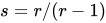
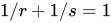


02Examples
When 
Rounding these numbers down to integers gives the sequence 
In this case, the complementary Beatty sequence is generated by

Rounding these values down to integers 
Every positive integer is in exactly one of these two sequences. These sequences define the optimal strategy for Wythoff's game, and are used in the definition of the Wythoff array.
As another example, for the square root of 2, 

For 

Any number in the first sequence is absent in the second, and vice versa.
03History
Beatty sequences got their name from the problem posed in The American Mathematical Monthly by Samuel Beatty in 1926. However, even earlier, in 1894 such sequences were briefly mentioned by Lord Rayleigh in the second edition of his book The Theory of Sound.
04Rayleigh theorem
Rayleigh's theorem (also known as Beatty's theorem) states that given an irrational number 

First proof
Given 

To see that no two of the numbers can occupy the same position (as a single number), suppose to the contrary that 



For any 



Likewise, the position of 
Conclusion: every positive integer (that is, every position in the list) is of the form 

Second proof
Collisions: Suppose that, contrary to the theorem, there are integers j > 0 and k and m such that


For non-zero j, the irrationality of r and s is incompatible with equality, so


Adding these together and using the hypothesis, we get

Anti-collisions: Suppose that, contrary to the theorem, there are integers j > 0 and k and m such that

Since j + 1 is non-zero and r and s are irrational, we can exclude equality, so

Then we get

Adding corresponding inequalities, we get


which is also impossible. Thus the supposition is false.
05Properties
A number 
![1-{\frac {1}{r}}<\left[{\frac {m}{r}}\right]_{1}](https://wikimedia.org/api/rest_v1/media/math/render/svg/189cbb7035d1de043001f96392ebf406596fb41f)
![[x]_{1}](https://wikimedia.org/api/rest_v1/media/math/render/svg/aed2a4c5d3c5b46012f671e4226dfd6ac574b87e)

![[x]_{1}=x-\lfloor x\rfloor](https://wikimedia.org/api/rest_v1/media/math/render/svg/5414db00b1ccbafd37539129bd588397d7f0438d)
Proof:



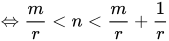
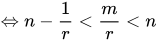
![\Leftrightarrow 1-{\frac {1}{r}}<\left[{\frac {m}{r}}\right]_{1}](https://wikimedia.org/api/rest_v1/media/math/render/svg/3f52ba9bc6ee3fb77c7bc07cd610c14ff2d3421a)
Furthermore, 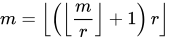
Proof:



![\Leftrightarrow 1-{\frac {1}{r}}<{\frac {m}{r}}-\left\lfloor {\frac {m}{r}}\right\rfloor =\left[{\frac {m}{r}}\right]_{1}](https://wikimedia.org/api/rest_v1/media/math/render/svg/fbbac1ba93b7062a7854be1b83295ba5732a0414)
Relation with Sturmian sequences
The first difference

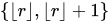
06Generalizations
If slightly modified, the Rayleigh's theorem can be generalized to positive real numbers (not necessarily irrational) and negative integers as well: if positive real numbers 

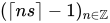


The Lambek-Moser theorem generalizes the Rayleigh theorem and shows that more general pairs of sequences defined from an integer function and its inverse have the same property of partitioning the integers.
Uspensky's theorem states that, if 


Sources and credits
This article is adapted from the Wikipedia article “Beatty sequence”, written by its contributors and licensed under CC BY-SA 4.0. Fathomly has changed the layout, removed citation markers, navigation and maintenance notices, and adjusted punctuation. This adapted version is shared under the same license. For references, see the original article.
Fathomly is not affiliated with or endorsed by the Wikimedia Foundation. Spotted a problem? Tell us.