Thompson sampling
Type of heuristic technique

Thompson sampling, named after William Rae Thompson, is a heuristic for choosing actions that address the exploration-exploitation dilemma in the multi-armed bandit problem. It consists of choosing the action that maximizes the expected reward with respect to a randomly drawn belief.
01Description
Consider a set of contexts 


The elements of Thompson sampling are as follows:
- a likelihood function
;
- a set
of parameters
of the distribution of
;
- a prior distribution
on these parameters;
- past observations triplets
;
- a posterior distribution
, where
is the likelihood function.
Thompson sampling consists of playing the action 

![\int \mathbb {I} \left[\mathbb {E} (r|a^{\ast },x,\theta )=\max _{a'}\mathbb {E} (r|a',x,\theta )\right]P(\theta |{\mathcal {D}})d\theta ,](https://wikimedia.org/api/rest_v1/media/math/render/svg/14f8aa2c07a9ef06f5af3d91e3e5389b49d35aa3)
where 
In practice, the rule is implemented by sampling. In each round, parameters 

![\mathbb {E} [r|\theta ^{\ast },a^{\ast },x]](https://wikimedia.org/api/rest_v1/media/math/render/svg/a3145dc902fd00d50a4eda4516cac9e03d3479d3)
02History
Thompson sampling was originally described by Thompson in 1933. It was subsequently rediscovered numerous times independently in the context of multi-armed bandit problems. A first proof of convergence for the bandit case has been shown in 1997. The first application to Markov decision processes was in 2000. A related approach (see Bayesian control rule) was published in 2010. In 2010 it was also shown that Thompson sampling is instantaneously self-correcting. Asymptotic convergence results for contextual bandits were published in 2011. Thompson Sampling has been widely used in many online learning problems including A/B testing in website design and online advertising, and accelerated learning in decentralized decision making. A Double Thompson Sampling (D-TS) algorithm has been proposed for dueling bandits, a variant of traditional MAB, where feedback comes in the form of pairwise comparison.
03Relationship to other approaches
Probability matching
Probability matching is a decision strategy in which predictions of class membership are proportional to the class base rates. Thus, if in the training set positive examples are observed 60% of the time, and negative examples are observed 40% of the time, the observer using a probability-matching strategy will predict (for unlabeled examples) a class label of "positive" on 60% of instances, and a class label of "negative" on 40% of instances.
Bayesian control rule
A generalization of Thompson sampling to arbitrary dynamical environments and causal structures, known as Bayesian control rule, has been shown to be the optimal solution to the adaptive coding problem with actions and observations. In this formulation, an agent is conceptualized as a mixture over a set of behaviours. As the agent interacts with its environment, it learns the causal properties and adopts the behaviour that minimizes the relative entropy to the behaviour with the best prediction of the environment's behaviour. If these behaviours have been chosen according to the maximum expected utility principle, then the asymptotic behaviour of the Bayesian control rule matches the asymptotic behaviour of the perfectly rational agent.
The setup is as follows. Let 




where the "hat"-notation 


,
where 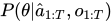


In practice, the Bayesian control amounts to sampling, at each time step, a parameter 

Upper-confidence-bound (UCB) algorithms
Thompson sampling and upper-confidence bound algorithms share a fundamental property that underlies many of their theoretical guarantees. Roughly speaking, both algorithms allocate exploratory effort to actions that might be optimal and are in this sense "optimistic". Leveraging this property, one can translate regret bounds established for UCB algorithms to Bayesian regret bounds for Thompson sampling or unify regret analysis across both these algorithms and many classes of problems.
Sources and credits
This article is adapted from the Wikipedia article “Thompson sampling”, written by its contributors and licensed under CC BY-SA 4.0. Fathomly has changed the layout, removed citation markers, navigation and maintenance notices, and adjusted punctuation. This adapted version is shared under the same license. For references, see the original article.
Images, from Wikimedia Commons:
- Visualization of Thompson sampling.gif by Nguiard, CC BY 4.0
Fathomly is not affiliated with or endorsed by the Wikimedia Foundation. Spotted a problem? Tell us.