Bayesian average
Type of average
A Bayesian average is a method of estimating the mean of a population using outside information, especially a pre-existing belief, which is factored into the calculation. This is a central feature of Bayesian interpretation. This is useful when the available data set is small.
Calculating the Bayesian average uses the prior mean m and a constant C. C is chosen based on the typical data set size required for a robust estimate of the sample mean. The value is larger when the expected variation between data sets (within the larger population) is small. It is smaller when the data sets are expected to vary substantially from one another.
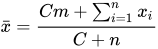
This is equivalent to adding C data points of value m to the data set. It is a weighted average of a prior average m and the sample average.
When the 

Sources and credits
This article is adapted from the Wikipedia article “Bayesian average”, written by its contributors and licensed under CC BY-SA 4.0. Fathomly has changed the layout, removed citation markers, navigation and maintenance notices, and adjusted punctuation. This adapted version is shared under the same license. For references, see the original article.
Fathomly is not affiliated with or endorsed by the Wikimedia Foundation. Spotted a problem? Tell us.