Baxter permutation
In combinatorial mathematics, a Baxter permutation is a permutation 
- There are no indices
such that
or
.
Equivalently, using the notation for vincular patterns, a Baxter permutation is one that avoids the two dashed patterns 

For example, the permutation 


These permutations were introduced by Glen E. Baxter in the context of mathematical analysis.
01Enumeration
For 


1, 2, 6, 22, 92, 422, 2074, 10754, 58202, 326240, 1882960, 11140560, 67329992, 414499438, 2593341586, 16458756586, ... (sequence A001181 in the OEIS)
In general, 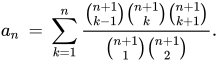
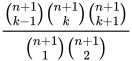


02Other properties
- The number of alternating Baxter permutations of length
is
, the square of a Catalan number, and of length
is

- The number of doubly alternating Baxter permutations of length
and its inverse
are alternating) is the Catalan number
.
- Baxter permutations are related to Hopf algebras, planar graphs, tilings, and rectangulations.
03Motivation: commuting functions
Baxter introduced Baxter permutations while studying the fixed points of commuting continuous functions. In particular, if 

![[0,1]](https://wikimedia.org/api/rest_v1/media/math/render/svg/738f7d23bb2d9642bab520020873cccbef49768d)


- the number of these fixed points is odd;
- if the fixed points are
then


- the permutation induced by
- under the natural relabeling
,
, etc., the permutation induced on
is a Baxter permutation.
Sources and credits
This article is adapted from the Wikipedia article “Baxter permutation”, written by its contributors and licensed under CC BY-SA 4.0. Fathomly has changed the layout, removed citation markers, navigation and maintenance notices, and adjusted punctuation. This adapted version is shared under the same license. For references, see the original article.
Fathomly is not affiliated with or endorsed by the Wikimedia Foundation. Spotted a problem? Tell us.